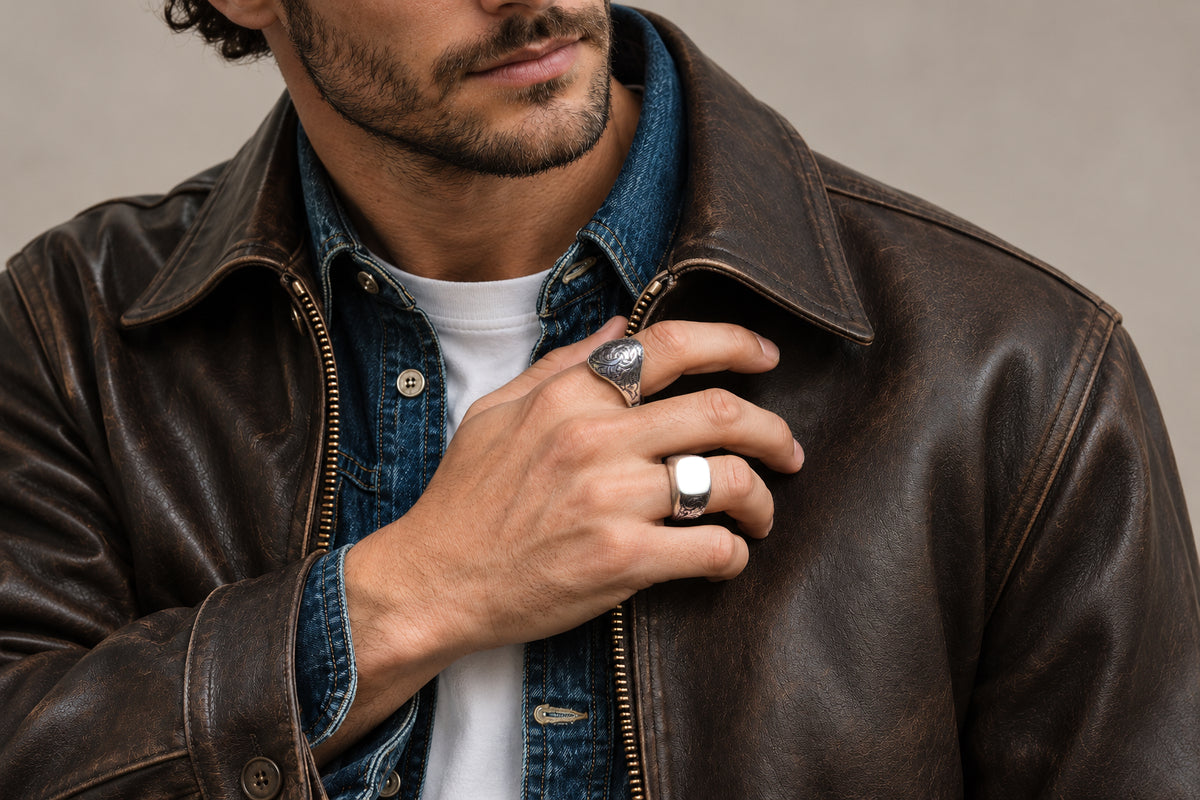


What Is Amekaji? From Its Origins to Its Popularity in Japan | An Overview of Its History and Fashion Culture

Denim jeans, plaid shirts, and work boots. Leather jackets, sweatshirts, and sneakers are also known as representative items of American casual fashion.
While this fashion has been enjoyed across generations, what exactly does "amekaji" mean in the first place?
While there is an image of it being a fashion born in the United States, the term "amekaji" as it is used today is deeply related to Japan's unique fashion culture.
Tracing its history, we can see that workwear worn by American workers, college student fashion, military uniforms, and outdoor wear, all with different backgrounds, were accepted in Japan and developed into a single genre.
In this article, we will explain the meaning and characteristics of amekaji, American clothing culture, its introduction to Japan, the Ivy look of the 1960s, the Shibukaji boom from the late 1980s to the 1990s, and its history up to the present day.
What is amekaji? Its meaning and fashion characteristics

Amekaji is an abbreviation for "American Casual" and refers to casual fashion derived from American clothing and lifestyle culture.
Representative items include denim jeans, T-shirts, sweatshirts, plaid shirts, leather jackets, sneakers, and work boots.
However, there is no single fixed outfit that defines amekaji.
It includes various styles, such as work style incorporating American workers' clothing, Ivy style rooted in college student fashion, and military style incorporating military uniforms.
What they have in common is incorporating clothing made for work, daily life, sports, and other activities into everyday wear.
Did amekaji originate in America? Or Japan?
There is one thing to distinguish when understanding amekaji.
That is, the origins of the clothing that make up amekaji and the establishment of the fashion genre called "amekaji" are not the same.
The roots of jeans, workwear, and college fashion lie in American history and lifestyle culture.
On the other hand, there is a history of grouping them together as "American casual" or "amekaji" and developing them uniquely within Japanese youth culture and the fashion market.
In Japan, interest in American culture spread after the war, and in the 1960s, the Ivy look, the West Coast culture in the 1970s, and Shibukaji in the late 1980s, among other styles, attracted attention one after another.
In other words, amekaji is also a fashion that has developed not only by simply reproducing American clothing but also through Japan's unique interpretations and ways of wearing them.
The roots of amekaji lie in American lifestyle culture
Many of the clothing items that make up amekaji were not originally made for fashion.
There are many that were born for practical purposes, such as durable workwear for workers, military uniforms worn by soldiers, everyday clothes worn by students, and clothing for sports and outdoor activities.
Here, we introduce representative clothing cultures that led to today's amekaji.
Workwear | Fashion born from workers' workwear

American workwear is indispensable when talking about amekaji.
One of the representative items is denim jeans.
On May 20, 1873, Levi Strauss and tailor Jacob Davis obtained a patent for a system of reinforcing work pants pockets and other areas with metal rivets.
At that time, in the American West, work requiring high durability of clothing was carried out in mines, farms, and railroad construction, and jeans reinforced in high-stress areas in addition to durable fabric developed as clothing used at such work sites.
In 1889, Carhartt, which is still known as a workwear brand today, was founded. It developed durable and work-appropriate overalls while incorporating the opinions of railroad workers.
As time went on, such workwear began to be incorporated into everyday wear and fashion items.
Jeans, overalls, and work jackets that are staples in today's amekaji have a history as practical clothing.
Military | A style incorporating the functionality of military uniforms
Military wear is also an important element of amekaji.
Military uniforms were made to support soldiers' activities and require functions such as warmth, durability, storage capacity, and ease of movement.
Items such as the MA-1 and A-2 flight jackets, M-51 parka, and military pants, which are also known in today's fashion, are items that incorporate the design of military clothing.
Military style, which wears these as everyday wear, is also treated as a subcategory of amekaji.
The rugged appearance and functional details are also used in outfits combined with work items such as denim and boots.
The author particularly liked the N-3 series. Especially around the early 2000s, the N-3B with a dog tag was one of the standard styles.
Also, many people wore military rings as a set.
Ivy College | American college student clothing
Unlike workwear and military, Ivy look has its roots in college student clothing.
Ivy is a term derived from the "Ivy League," a group of prestigious universities in the northeastern United States.
The representative outfit combines a navy blazer, button-down shirt, chino pants, and loafers.
In Japan, the Ivy look became popular in the 1960s, and American college student clothing became one of the fashion styles that young people admired.
Although it looks different from amekaji centered on denim and leather jackets, it is a style that played an important role in establishing American clothing culture in Japan.
Although it is an elegant style of fashion, just as a college ring is talked about as a standard set, highly decorated rings are also standard items of Ivy style.
Western, Biker, Outdoor Culture

Amekaji also incorporates various other American lifestyle cultures.
In Western style, which has its roots in cowboy clothing, Western shirts and boots are representative.
In styles incorporating bike culture, leather jackets, denim, and engineer boots are used.
Also, from outdoor and surfing cultures, functional jackets, sweatshirts, T-shirts, sneakers, and other items are incorporated into everyday fashion.
The characteristic of amekaji is that these multiple cultures coexist not as one fixed outfit, but as various ways of dressing.
The history of amekaji spreading in Japan
How did American clothing and lifestyle spread in Japan?
Tracing its history, we can see that it started with imported clothing after the war and was involved with fashion brands, magazines, youth culture, and the development of domestic clothing.
1940s–1950s | Post-war American culture and imported clothing
After World War II, American military surplus and used clothing began to circulate in Japan.
At places such as Ueno's Ameyoko in Tokyo, clothing brought in from America was sold, creating opportunities to encounter jeans and military clothing.
For Japan at that time, American clothing was different from clothing generally sold domestically.
Along with the post-war interest in American culture, an American-style lifestyle spread among young people through movies, music, fashion, and other means.
Even before the formation of amekaji culture in Japan, American-made clothing was gradually becoming more familiar.
1960s | Ivy look and the "Miyuki-zoku" trend

In the 1960s, Ivy look, which was based on American college student clothing, became popular among Japanese youth.
One of the major contributors to its spread was the fashion brand "VAN," created by Kensuke Ishizu.
VAN introduced American traditional style to Japan from the 1950s and promoted the spread of Ivy look in the 1960s.
In 1964, young people wearing Ivy look gathered around Miyuki Street in Ginza, Tokyo, and came to be called the "Miyuki-zoku."
Outfits incorporating button-down shirts and slim pants became one of the fashion styles symbolizing youth culture at that time.
Furthermore, in 1965, the photo book "TAKE IVY," which photographed American Ivy League college students, was published.
This photo book, which introduced what American college students actually wore, is an important material in telling the history of Ivy fashion in Japan.
1960s–1970s | The birth of domestic jeans and the development of denim culture
While American clothing attracted attention in Japan, domestic jeans manufacturing was also promoted.
The predecessor company of BIG JOHN, based in Kojima, Kurashiki, Okayama Prefecture, started importing jeans and contract production in 1958.
And in 1965, it manufactured domestic jeans using imported denim fabric.
At that time, Japan did not have sufficient technology and equipment to sew thick denim fabric, and trial and error such as modifying sewing machines was necessary.
After that, in 1973, it announced pure domestic jeans using domestic denim fabric born from joint development with Kurashiki Spinning.
Jeans, which had only been imported from America to wear, changed into clothing manufactured within Japan.
This step was one of the important processes in the development of Japan's unique denim culture.
1970s | West Coast culture and fashion magazine "POPEYE"

In the 1970s, the lifestyle of the American West Coast also began to be introduced in Japan.
One of the media symbolizing that trend is the magazine "POPEYE," founded in 1976.
The inaugural issue focused on California and covered skateboarding, jogging, sneakers, sportswear, college life, and other topics.
This not only introduced American-made clothing but also conveyed how American young people enjoyed their lives.
Not only clothing, but interest in lifestyle including sports, music, the city, and hobbies also connected to fashion.
The existence of such magazines played a role in introducing American casual to Japanese readers not merely as imported clothing, but as a culture.
Late 1980s | "Shibukaji" spreading from Shibuya
In the late 1980s, "Shibukaji," which is indispensable when talking about Japan's unique amekaji culture, appeared.
Shibukaji is an abbreviation for "Shibuya Casual," and it is a style that spread from the fashion of young people gathering in Shibuya at that time.
While incorporating American-made jeans, sweatshirts, plaid shirts, blazers, sneakers, and other items, young people created their own ways of dressing.
From the beginning, it was not one brand that determined the clothing, but young people around Shibuya and shops handling imported clothing were involved in forming the trend.
From the late 1980s to the early 1990s, Shibukaji became one of the representative trends of Japanese fashion.
1990s | Leather jackets, denim, boots, and the amekaji boom

As the Shibukaji trend spread, various American casual items attracted attention.
Representative items include Levi's 501, Bronson leather jackets, Avirex B-3, Red Wing engineer boots, Ralph Lauren shirts and blazers, and other items.
Also, Goro's jewelry is featured in fashion media as an item symbolizing that time.
Combining accessories with denim, leather jackets, and boots was also one of the amekaji cultures of that time.
During this period, interest in vintage clothing and American products also deepened, and ways of enjoying it that focused on the age of clothing, manufacturing methods, and brand history spread.
Amekaji not only incorporated American trends but also developed as a fashion where Japanese young people found the background and value of clothing and created their own ways of dressing.
As a side note, Brad Pitt appearing in an EDWIN commercial was also one of the triggers for the denim boom.
Why Japanese amekaji became a unique culture
Japanese amekaji, which incorporated American clothing, did not stop at a culture of merely wearing imported items.
One of its characteristics is the interest in the history and manufacturing methods of clothing.
For example, with jeans, the denim fabric used, sewing methods, fading, and differences in details by age began to be appreciated.
Japanese manufacturers also did not merely imitate American products but worked on fabric development and sewing technology improvements.
BIG JOHN completing pure domestic jeans in 1973 is also an example showing the development of such Japanese craftsmanship.
Also, in Shibukaji from the late 1980s, American brands and vintage clothing were uniquely combined by Japanese young people.
Clothing with roots in American lifestyle culture was reinterpreted by Japanese cities, shops, magazines, and the people who wore them, which is a major characteristic of Japanese amekaji culture.

Modern amekaji fashion

Amekaji is not a fashion that ended with the 1980s–90s boom.
Jeans, T-shirts, sweatshirts, leather jackets, work boots, and other items are still enjoyed as standard casual items today.
Also, amekaji outfits have changed over time.
In the fashion magazine "Pen," amekaji, which is attracting attention again around 2020, is introduced not only as the conventional American traditional but also as a style that crosses street, outdoor, sports, and other styles.
Today's amekaji is not only something that simply reproduces past trends.
There are outfits centered on vintage denim, and styles that combine modern silhouettes of sweatshirts and sneakers.
Incorporating long-history standard items to fit today's fashion can also be said to be a characteristic of amekaji.
The relationship between amekaji and silver accessories
Looking back at the history of amekaji, we can see that not only clothing but also accessories have been incorporated as part of fashion.
Especially during the Shibukaji boom from the late 1980s to the early 1990s, silver jewelry attracted attention along with denim, leather jackets, work boots, and other items.
For example, in an article from "WWDJAPAN" introducing representative items of that time, Goro's jewelry is listed as one of the items symbolizing Shibukaji.
Even today, silver rings, bangles, necklaces, and other items can be combined with amekaji outfits incorporating denim and leather.
Also, silver accessories have various designs, from simple ones to those with carvings and decorations.
Not only combining with clothing, but also paying attention to the characteristics of patterns and decorations is one of the joys of choosing accessories.
At IMULTA, we produce hand-engraved jewelry silver accessories that engrave patterns on the metal surface using special tools.
Decorations engraved in the metal, such as arabesque patterns with plant motifs, are also characteristics of the design.
Regarding the combination of amekaji and silver accessories, it is introduced in detail in the separate article "Complete Guide to Silver Accessories That Match Amekaji."

Summary | Amekaji is a fashion that fuses American culture and Japanese sensibility
Amekaji is a general term for casual fashion incorporating clothing derived from American lifestyle culture.
Behind it are various histories, such as jeans and workwear born for workers, military uniforms, college student clothing, and outdoor and bike cultures.
In Japan, American-made clothing circulated after the war, and through the Ivy look of the 1960s, the West Coast culture of the 1970s, and the Shibukaji boom from the late 1980s to the 1990s, it developed into a unique fashion culture.
The charm of amekaji is that long-history items can be incorporated into today's outfits.
Not only standard items such as denim and leather jackets, but also by combining silver accessories, the expression of the outfit expands.
For those who want to know how to choose silver rings and accessories to match amekaji, please also see the "Complete Guide to Silver Accessories That Match Amekaji."