The meaning and origin of the grape motif used in decoration
The Meaning and Origins of the Grape Motif Used in Japan Since Ancient Times

The grape pattern has been used in Japan since ancient times, having been introduced during the Nara period.
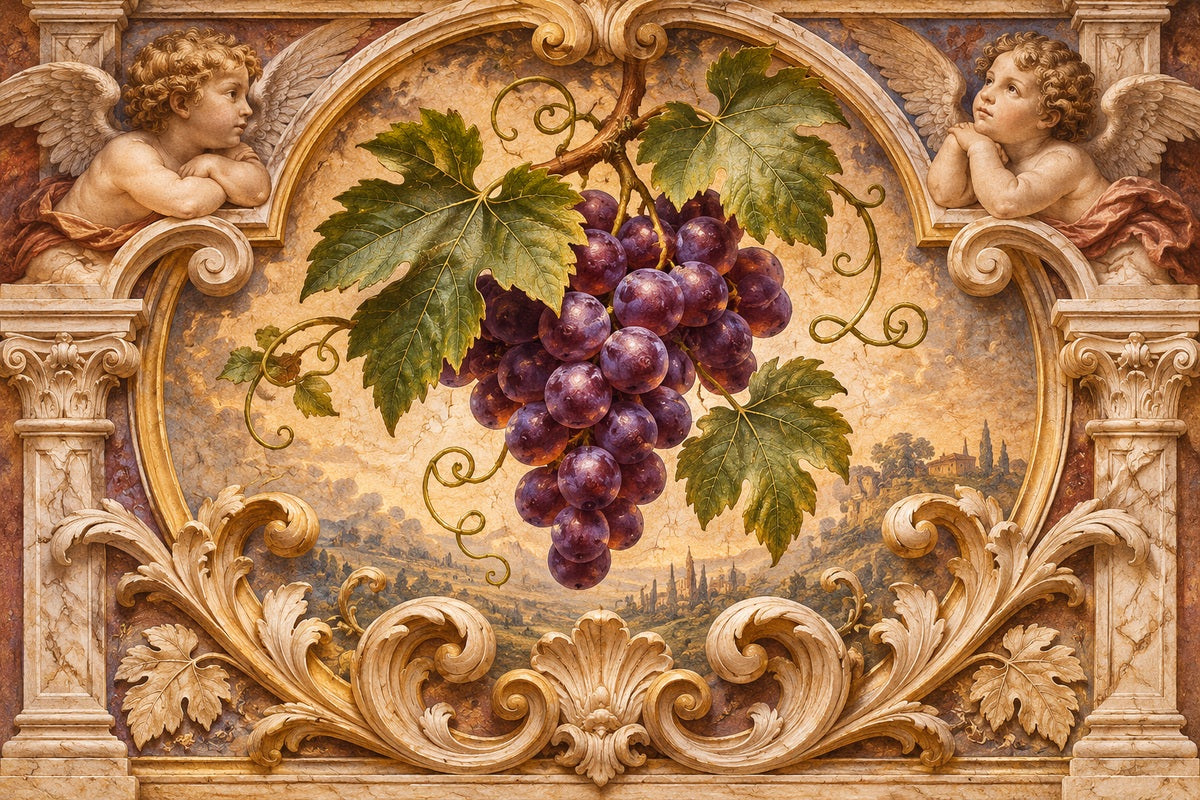
Because grapes bear many berries, they are considered a motif symbolizing fertility and abundance.
In ancient Greece, many sculptures and vase paintings depict grapes alongside Dionysus, the god of wine and festivals.
In Christian art, grapevines were used as a decoration representing the bond between Christ and his followers. Furthermore, because wine symbolizes the blood of Christ, grapes and vines became motifs with religious significance.
Vines used in sacred tree motifs and illuminated manuscripts are also depicted as grapevines.
Much like the interlaced designs that cover entire pages in Celtic art, such as the Book of Kells, the highly developed grape arabesque motif clearly expresses its characteristics, with leaves, fruit, and vines densely filling the space—a true symbol of fertility and abundance.
Even when uncolored, it overwhelms the viewer.
The Grape Motif, Widely Adopted in Japan
The grape arabesque pattern, combining grape clusters, leaves, and vines, was introduced to Japan via the Silk Road and used to decorate buildings and crafts from the late Asuka period through the Nara period.
The grape motif introduced to Japan is also frequently seen among the treasures of Emperor Shomu's Shosoin Repository.
From there, it was also used in obi patterns, giving rise to the grape and squirrel motif, a lucky pattern combining grapes and squirrels (Japanese flying squirrels), which was used not only on kimonos and obi but also as building decoration. The artist Kanemasa Shibata also painted grape and squirrel designs.
Because grapes bear many fruits, they symbolize fertility and abundance, while squirrels, which give birth to many offspring at once, also signify fertility and the prosperity of descendants.
Interestingly, the grape arabesque pattern is also used in Japanese Buddhist art.
A representative example is the base of the seated statue of Yakushi Nyorai enshrined in the Golden Hall of Yakushi-ji Temple in Nara Prefecture, where the grape arabesque pattern is incorporated as decoration.
Differences in the Meaning of the Grape Motif in the West and Japan
Grapes have been used in decoration in both the West and Japan since ancient times, but their symbolic meanings differ depending on religion and culture.
| Comparison Item | The West | Japan |
|---|---|---|
| Main Symbolism | Wine, festivals, abundance, the bond with Christ | Fertility, abundance, prosperity of descendants, good fortune |
| Historical Background | Appears in ancient Greek and Roman mythology and festivals, and later in Christian art | The grape arabesque pattern introduced from the continent is seen in the art and crafts of the late Asuka and Nara periods |
| Relationship with Religion | Associated with wine and festivals in the cult of Dionysus. In Christianity, the grapevine symbolizes the bond between Christ and his followers, while wine symbolizes the blood of Christ | The grape arabesque pattern was also incorporated into Buddhist art and used to decorate temples and Buddhist statues |
| Representative Patterns | Botanical decoration combining grapevines, clusters, and leaves | Grape arabesque pattern, grape and squirrel motif (budōrisumon) |
| Accompanying Motifs | Dionysus, putti (child figures), religious figures or scenes | Squirrels (Japanese flying squirrels), arabesque and other plant patterns |
| Representative Examples of Use | Ancient vase paintings, sarcophagus carvings, church art, illuminated manuscripts | Shosoin treasures, temple decorations, paintings, kimonos, obi, lacquerware |
In this way, while grapes are associated with ancient wine cults and Christianity in the West, they are known in Japan as a lucky pattern wishing for fertility and the prosperity of descendants.

Summary | The Meaning and History Behind the Grape Motif
The grape motif is a plant pattern that has been incorporated into art and architectural crafts around the world since ancient times.
In ancient Greece and Rome, it was associated with wine, festivals, and abundance, while in Christian art, it symbolized the connection between Christ and his followers and the Eucharist, taking on different meanings depending on the era and culture.
In Japan, the grape arabesque pattern spread from the late Asuka period through the Nara period and was incorporated into the decorations of Shosoin treasures and Buddhist art.
Since then, it has remained popular as a lucky pattern wishing for the prosperity of descendants and abundance, such as the grape and squirrel motif combining grapes and squirrels.
The rich forms created by the interplay of grape berries, leaves, and vines are not merely botanical decorations; they have been passed down throughout history as motifs expressing people's faith and wishes.