

Symbolism and evolution of the lotus motif from ancient Egypt
What Is the Lotus Motif? A Plant Pattern Symbolizing Rebirth and Eternal Life in Ancient Egypt

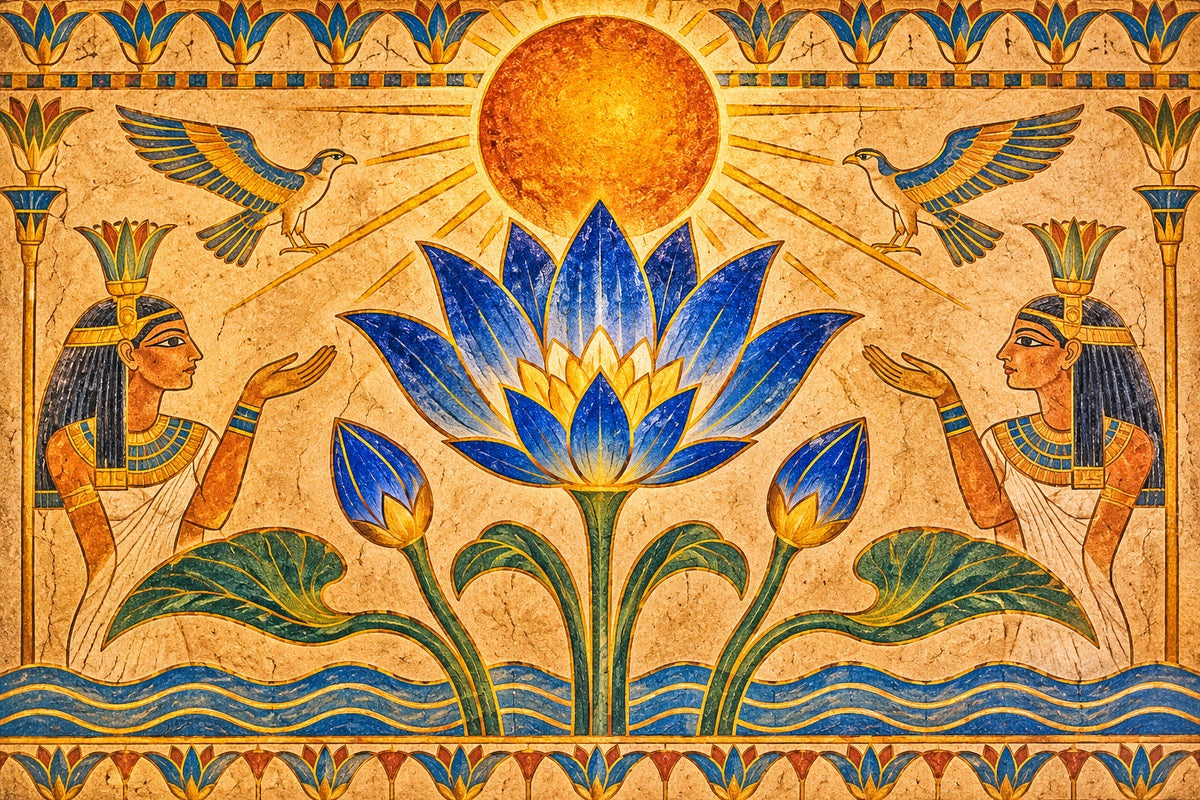
The lotus (Lotus) is a decorative motif that has been widely used in temples, tombs, wall paintings, and crafts in ancient Egypt as a plant symbolizing the rebirth of life and eternal life.
Particularly important is the lotus flower's tendency to open in the morning and close at night.
The people of ancient Egypt associated this blooming cycle with the sun rising every morning and regarded it as a symbol of life being repeatedly reborn.
The lotus was not merely a floral decoration, but a plant deeply connected to ancient Egyptian religious beliefs, such as the birth of the sun, the rebirth of life, and resurrection after death.
Its distinctive flower and bud shapes were also incorporated into architectural decoration, and in the later Mediterranean world, it was used in decorations combined with plant motifs such as palmettes.
What Kind of Plant Is the Lotus? The Difference Between Water Lilies and Lotuses
The plant known as the lotus in ancient Egyptian art is primarily a species of water lily.
In Japan, the word lotus is sometimes translated as "hasu" (lotus), but the lotus that appears in ancient Egyptian decoration and the lotus commonly known in Japan differ in their botanical classification.
Representative Lotuses of Ancient Egypt
- Blue Lotus (Nymphaea caerulea): A water lily species with blue petals. It was frequently depicted in ancient Egyptian art and crafts.
- White Lotus: A water lily species that produces white flowers. It was also known in ancient Egypt.
- Lotus Common in Japan (Nelumbo nucifera): A plant in the Nelumbaceae family, which is classified differently from the water lily family.
When understanding ancient Egyptian lotus motifs, focusing on the blue water lily makes it easier to see their relationship with the decorations of the time.
The Relationship Between the Opening and Closing of Flowers and the Sun
The lotus, which was highly valued in ancient Egypt, has the tendency to open its flowers in the morning and close them at night.
This movement was associated with the movement of the sun, which reappears from the darkness of night.
For this reason, the lotus appears in ancient Egyptian art as a plant representing the new life that arrives every morning and the repeated rebirth.
The Meaning Symbolized by the Lotus Motif
Ancient Egyptian lotus motifs have multiple meanings derived from the characteristics of the plant and religious beliefs.
Representative Symbols and Meanings
- Rebirth of Life: The tendency to open its flowers in the morning was associated with the birth of new life.
- Eternal Life: It is related to the ancient Egyptian belief in being reborn after death.
- The Sun and Creation: It appears in myths representing the birth of the sun and the creation of the world.
- Rejuvenation and Restoration of Vitality: From the sight of flowers repeatedly opening, it was associated with youthfulness and the renewal of life.
- Symbol of Upper Egypt: The lotus was also used as a plant representing Upper Egypt, the southern region of ancient Egypt.
Particularly important is the relationship between the rebirth of life and the sun.
The reason lotus decorations were used not only in temples but also in tombs and funerary goods was the belief that life would be reborn in the afterlife.
The Lotus and the Birth of the Sun in Ancient Egyptian Mythology
In ancient Egyptian creation myths, it was believed that before the world was born, primordial waters spread out.
There is a mythological expression that a lotus flower appeared from those waters, bloomed, and the sun was born from it.
For this reason, the lotus was associated not only with the rebirth of life but also with the beginning of the world itself.
The Lotus and the God Nefertum
Nefertum is known as a god deeply connected with the lotus.
Nefertum is a god related to youthful vitality and rebirth, and was also associated with the newly born sun.
In ancient Egyptian art, he is sometimes depicted with a lotus flower on his head.
In fact, the Metropolitan Museum of Art houses an amulet of the god Nefertum with a lotus on his head.
From such works, we can see that the lotus was an important plant with mythological meaning.
Lotus Motifs Used in Ancient Egyptian Temples and Tombs
Lotus motifs were widely incorporated into ancient Egyptian architecture and crafts.
Their uses range from temple column capitals to small amulets.
Temple Column Capital Decorations
Many plant-shaped columns can be seen in ancient Egyptian architecture.
In lotus-motif column capitals, shapes based on flower buds and open flowers were used.
The architectural model from the Middle Kingdom period housed by the Metropolitan Museum of Art also reproduces column capitals modeled after bundles of lotuses.
In this way, the lotus was not only depicted in mythological and religious scenes but was also incorporated into the shapes of the architecture itself.
Lotuses Depicted in Tombs and Funerary Goods
The lotus was also used in decorations expressing the wish that the deceased would be reborn in the afterlife.
The Metropolitan Museum of Art houses a faience pot depicting lotus flowers and buds, excavated from a tomb dating to around the 15th century BCE.
The vessel combines open lotuses and closed buds, and is described as a decoration representing the rebirth of life.
Such works show that lotus motifs were incorporated not only into tomb decorations but also into funerary goods.
Lotuses Also Used in Amulets and Small Crafts
Lotus decorations were not limited to large temples and wall paintings.
Lotus flowers and buds were also carved into scarab-shaped amulets and small ornaments.
The Middle Kingdom scarab-shaped amulet housed by the Metropolitan Museum of Art is decorated with a combination of four lotus flowers.
Such plant decorations were incorporated into small crafts as symbols representing life and rebirth.
Main Examples of Lotus Motif Usage
- Temple Column Capitals: Expressing the shapes of lotus buds and flowers as architectural decoration.
- Tombs and Funerary Goods: Used as a symbol expressing the wish for rebirth after death.
- Wall Paintings and Reliefs: Appearing in scenes of gods, offerings, and religious events.
- Vessels and Decorative Containers: Stylizing lotus petals and buds into patterns.
- Amulets: Used as small decorations representing the rebirth of life.

The Difference Between the Lotus and Papyrus | Plants Symbolizing Ancient Egypt
In ancient Egyptian decoration, papyrus was also an important plant motif alongside the lotus.
These two plants symbolized different regions of Egypt.
| Comparison Item | Lotus | Papyrus |
|---|---|---|
| Plant Characteristics | A water lily species that blooms on the water surface | A tall plant growing by the water |
| Symbolized Region | Upper Egypt (South) | Lower Egypt (North) |
| Representative Meaning | Rebirth, life, and relationship with the sun | Abundant life by the water, symbol of Lower Egypt |
| Decorative Expression | Petals, open flowers, buds | Long stems, inflorescence spreading at the top |
The lotus and papyrus were also sometimes expressed together as plants representing the north and south of Egypt.
Decorations combining the two have the meaning of expressing the unification of Upper Egypt and Lower Egypt.
The Spread of the Lotus Motif Around the World
Decorations based on the lotus flower can be seen not only in ancient Egypt but also in the Mediterranean world, including Greece and Rome.
Ancient plant decorations were adopted across regions and developed into different forms within each art style.
Ancient Greek Lotus Motif
In ancient Greek decoration, motifs stylizing the lotus flower and bud were used.
While connections with the plant decorations used in ancient Egypt have been pointed out, they were also incorporated into Greece's unique decorative compositions.
In particular, decorations placing the shape of the flower symmetrically on the left and right, or alternating it with palmette motifs, are known.
These plant motifs were used in architecture, pottery, and other items.
Roman-Era Lotus Decoration
Decorations combining the lotus and palmette can also be seen in Roman-era crafts.
The Metropolitan Museum of Art houses a mosaic glass decorative panel combining the lotus and palmette from around the late 1st century BCE to the 1st century CE.
In these works, flowers and leaves are arranged symmetrically on the left and right, forming a single motif along with spiral decorations.
While the lotus had a strong connection with the sun and rebirth in ancient Egypt, it was also widely used in works of the Greek and Roman worlds as a decorative element utilizing the shape of the plant.
Lotus Used in Combination with Palmette Motifs
Important for understanding the development of the lotus motif is its combination with the palmette.
The palmette is a plant motif stylizing fan-shaped spreading leaves, and has been widely used in ancient architecture and crafts.
Difference in Shapes Between the Lotus and Palmette
| Comparison Item | Lotus Motif | Palmette Motif |
|---|---|---|
| Basic Shape | Flowers with opening petals and long, slender buds | Shape with leaves spreading in a fan shape |
| Formal Characteristics | Emphasizes the outline of the flower and petals | Emphasizes leaves spreading left and right from the center |
| Main Examples | Ancient Egyptian temples, tombs, vessels, amulets | Ancient Greek and Roman architecture and crafts |
| Combination | Examples of being placed alternately with the palmette | Examples of being placed alternately with the lotus |
What Are Lotus and Palmette Motifs?
Decorations alternating the lotus and palmette, or connecting them with spiral curves, can be found in ancient Greek and Roman art.
Their characteristic is arranging flowers and leaves according to a certain rule to create continuous decoration.
The MIHO MUSEUM also houses a plant motif decorative panel combining the lotus and palmette.
These works show that plant-based patterns were passed down across eras and regions and developed into various decorative forms.
Representative Forms and How to Distinguish Lotus Motifs
There are multiple ways of expressing lotus decorations that spread from ancient Egypt to the Mediterranean world.
The representative forms can be organized as follows.
- Blooming Lotus: A pattern expressing petals spreading outward. In ancient Egypt, it is an important form associated with rebirth.
- Lotus Bud: A pattern expressing the shape of a closed flower. It was used in column capitals and architectural decorations.
- Continuous Lotus: A decorative form repeatedly arranging flowers or buds. It can be seen in architectural and craft border decorations.
- Lotus and Palmette Combination: A decoration combining flowers and fan-shaped leaves. There are examples in Greek and Roman architecture and crafts.
Because the degree of stylization of lotus motifs varies by era and region, they are not necessarily depicted in the same shape as actual water lily flowers.
When looking at the pattern, focusing on the shape of the petals, the outline of the bud, and the combination with surrounding palmettes or spiral decorations makes it easier to understand its characteristics.

Summary | Lotus Motifs Inherited from Ancient Egypt
The lotus is an important plant motif associated with the sun, the rebirth of life, and eternal life in ancient Egypt.
From its tendency to open its flowers in the morning and close them at night, it was widely incorporated into temples, tombs, amulets, and crafts as an entity symbolizing the birth of the sun and resurrection after death.
After that, decorations stylizing lotus flowers and buds were also used in the Mediterranean world and developed as plant motifs combined with palmettes.
The lotus motif is a motif that conveys the symbolic meaning ancient Egyptians found in the vitality of plants and the history of decorative art developed over a long period of time.

