

Meaning and Origin of the Scarab|Ancient Egyptian Amulet and Symbol of Rebirth
What Is a Scarab? A Sacred Insect Symbolizing Rebirth in Ancient Egypt

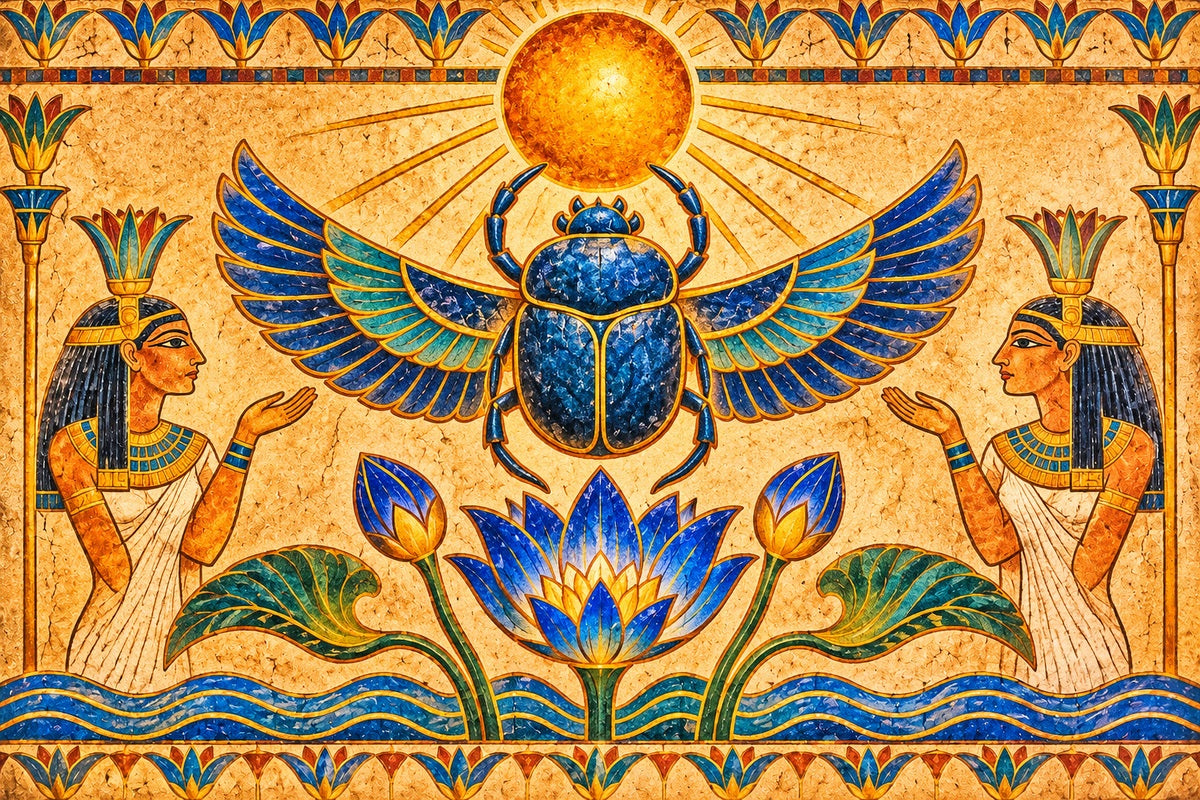
A scarab (Scarab) is a beetle modeled after the dung beetle, which was revered in ancient Egypt as a sacred symbol of the sun and the rebirth of life.
In ancient Egypt, many amulets and ornaments shaped like scarabs were made. Their form was incorporated into rings, bracelets, seals, and protective amulets placed in tombs.
The reason scarabs held such special meaning lay in the dung beetle's habit of rolling balls of dung and its life cycle, in which new life appeared to emerge from them.
Ancient Egyptians likened the sight of the insect carrying a round ball to the sun moving across the sky. Furthermore, they associated the emergence of new insects from the ground with the birth and rebirth of life.
Thus, the scarab became one of ancient Egypt's most iconic amulets.
The Meaning of the Scarab | Why It Symbolized the Sun, Rebirth, and Life
The meaning imbued in the scarab was not merely to wish for good luck. It was deeply connected to ancient Egyptian sun worship and beliefs about the afterlife.
The Primary Meanings Symbolized by the Scarab
- The Birth of Life:The emergence of insects from the ground was associated with the appearance of new life.
- Rebirth and Resurrection:It symbolized the renewal of life, likened to the sun rising every morning.
- The Sun:The act of rolling a round ball was likened to the sun moving across the sky.
- Rebirth in the Afterlife:It was used as an amulet to wish that the deceased would regain life in the afterlife.
- Protection:It was used as an amulet to protect the wearer and was also fashioned into seals.
Why the Dung Beetle Became a Sacred Being
The dung beetle, which served as the model for the scarab, has the habit of rolling animal dung into balls and pushing them along with its hind legs.
This sight of rolling a ball reminded ancient Egyptians of the movement of the sun.
Furthermore, some species of dung beetles lay eggs in balls of dung. The larvae grow inside them and eventually emerge as adults.
However, ancient Egyptians could not fully observe the process from egg to adult.
For this reason, scarabs were thought to be born naturally from the ground and were regarded as beings with the power to create life.
The movement of the sun and the birth of life. These two images linked the scarab to the symbol of rebirth.
The Relationship Between the Sun God Khepri and the Scarab
The scarab was revered in ancient Egypt partly due to its connection with the sun god Khepri.
Khepri was the sun god associated with the rising morning sun, and he was sometimes depicted in the form of a scarab or as a human with a scarab head.
The Idea of the Dung Beetle Carrying the Sun
In ancient Egypt, the sun rising in the eastern sky in the morning, setting in the west in the evening, and reappearing the next morning held great significance.
This movement was likened to the way a scarab pushes and carries a round ball.
The depiction of the sun as a ball, with a scarab pushing the sun into the sky, also appears in ancient Egyptian art.
Because the sun reappeared every morning, the scarab came to symbolize not only the sun itself but also the cyclical rebirth of life.
The Scarab and the Word "To Become"
The scarab also has an important connection with the ancient Egyptian language.
The ancient Egyptian word "kheper" meant "to come into being" or "to exist," and it was related to the word for scarab and the name of the sun god Khepri.
The scarab form was also used in hieroglyphs and was associated with words representing the birth and transformation of life.
In other words, the reason the scarab symbolized rebirth was related not only to the insect's habits but also to the meaning of words in the ancient Egyptian language.

When Were Scarab Amulets First Used?
Amulets shaped like scarabs are believed to have been made starting in the First Intermediate Period of ancient Egypt, around the end of the third millennium BCE.
They later became widely popular as amulets during the Middle Kingdom and began to be used as seals.
Scarab decorations continued into the New Kingdom and were used through the Late Period and into the Greco-Roman period.
Periods in Which Scarabs Were Used
| Period | Approximate Dates | Scarab Use and Characteristics |
|---|---|---|
| First Intermediate Period | Around 2100 BCE | Early scarab-shaped amulets appear |
| Middle Kingdom | Primarily around 2000–1700 BCE | Became popular as amulets and were also used as seals engraved with names and titles |
| New Kingdom | Around 1550–1070 BCE | Used as amulets, ornaments, seals, and funerary scarabs |
| Late Period Onward | From around the 7th century BCE onward | Continued use as amulets, with funerary decorations such as scarabs with outstretched wings also seen |
The Metropolitan Museum of Art houses a variety of scarabs made during these periods.
Their use over thousands of years shows that the scarab was a long-cherished symbol in ancient Egypt.
Types of Scarab Amulets Used in Ancient Egypt
Scarab ornaments came in several types, with their shape, size, and engravings on the back varying depending on their intended use.
Representative types include wearable amulets, scarabs that also served as seals, heart scarabs for the deceased, and scarabs with outstretched wings.
1. Wearable Scarab Amulets
Scarabs were used as amulets to wish for the life and rebirth of the wearer.
Small scarabs could be pierced with a hole for threading on a cord or incorporated into rings and bracelets.
The Metropolitan Museum of Art houses scarab rings and bracelets made during the Middle Kingdom.
These ornaments show that ancient Egyptians incorporated scarabs into their everyday lives as personal amulets.
2. Scarabs Used as Seals
Some scarabs served as seals as well as amulets.
These were sculpted in the form of a beetle on the top, while the flat back was engraved with the owner's name or title, letters, or images of deities.
By pressing the back onto clay or another material, the engraved letters and images could be reproduced.
During the Middle Kingdom, many scarab seals were made, engraved with the names and titles of officials.
A major feature was that they combined the symbolic meaning of an amulet with the practical function of a seal.
3. Heart Scarabs (Heart Scarabs)
Heart scarabs were special amulets prepared for the deceased.
In ancient Egypt, the human heart was considered important not only for life but also for thought, memory, and moral conduct.
It was believed that in the afterlife, the heart would be weighed against Maat, the symbol of justice and order, to judge the deeds of the deceased's life.
Heart scarabs were amulets intended to prevent the heart from testifying against the deceased during this judgment.
The backs of larger scarabs were sometimes engraved with spells such as Chapter 30B of the Book of the Dead and placed on the chest of the mummy.
The heart scarab of Hatenefere housed by the Metropolitan Museum of Art is a New Kingdom piece made of green stone and a gold chain. The back is engraved with a spell related to the judgment in the afterlife.
4. Scarabs with Outstretched Wings
Scarab ornaments also came in forms with greatly outstretched wings.
These wings were not always a direct representation of an actual beetle's wings; some examples were shaped like bird wings.
Winged scarabs were used as funerary amulets and attached to the linen wrappings or bead nets of mummies.
The Metropolitan Museum of Art houses winged scarab amulets from around 664–332 BCE.
They were used as symbols of rebirth, expressing the wish that the deceased would regain life.
Comparison of Scarab Types and Meanings
Scarab ornaments were not all made for the same purpose.
The following comparison shows representative scarabs used in ancient Egypt.
| Type | Primary Purpose | Shape and Characteristics | Examples of Use |
|---|---|---|---|
| General Scarab Amulet | Protection, life, rebirth | Small beetle shape | Rings, bracelets, wearable amulets |
| Scarab Seal | Protection and sealing function | Flat back engraved with letters or images | Sealing documents, containers, doors, etc. |
| Heart Scarab | Preparation for the judgment in the afterlife | Relatively large, often with spells engraved on the back | Placed on the chest of the mummy |
| Winged Scarab | Wishing for the rebirth of the deceased | Combines a beetle body with bird wings | Attached to mummy linen or bead nets |
General scarab amulets were also used as ornaments by living people.
Heart scarabs and winged scarabs, on the other hand, played an important role as funerary amulets related to the afterlife and resurrection.

History of Scarab Jewelry and Ornaments
The scarab was not only a religious symbol but also a decorative motif used in ancient Egyptian jewelry and crafts.
Existing pieces range from small carved stone amulets to metal rings and bracelets combined with gemstones.
Rings Made with Scarabs
Scarab rings were actually made as ornaments in ancient Egypt.
The Metropolitan Museum of Art houses a scarab ring made of amethyst and copper from the Middle Kingdom, around 1981–1802 BCE.
Such rings are one example of how scarabs were used as wearable amulets.
Bracelets Made with Scarabs
Scarabs were also incorporated into bracelets.
A bracelet made with scarabs was excavated from the tomb of the Middle Kingdom figure Wah.
Among them was a scarab made with lapis lazuli, and the Metropolitan Museum of Art explains that the use of lapis lazuli, which was difficult to obtain in Egypt at the time, indicates Wah's high status.
While scarabs were symbols of protection and rebirth, they also had an aspect as ornaments made with precious materials.
Materials Used to Make Scarabs
Various materials were used to make scarabs in ancient Egypt.
- Faience:A man-made material with a glaze-like shine on the surface. Blue and green scarabs survive today.
- Steatite:A stone that is easy to carve, used for glazed scarab seals and other items.
- Lapis lazuli:A gemstone with a vivid blue color. It was also used in ornaments made with scarabs.
- Amethyst:A purple gemstone. Examples exist of scarab rings made with amethyst.
- Jasper:Examples remain of scarab amulets carved from jasper.
- Metals such as gold and copper:Used for ring settings and chains connecting amulets.
Ancient scarabs range from simple beetle shapes to those with finely carved backs and legs.
Many pieces were also engraved with deities or hieroglyphs on the back, developing into crafts that combined decoration with symbolic meaning.
Commonalities Between Scarabs and Lotuses | Symbols of Rebirth in Ancient Egypt
In ancient Egypt, motifs other than scarabs were also used to symbolize the rebirth of life.
A representative example is the lotus pattern based on the blue water lily.
The lotus, which opens in the morning and closes at night, was associated with the movement of the sun.
On the other hand, the way a scarab rolls a round ball was likened to the movement of the sun, and its emergence from the ground was associated with the birth of new life.
| Comparison Item | Scarab | Lotus |
|---|---|---|
| Motif | Dung beetle | Water lily flower |
| Symbolic Meaning | Sun, birth of life, rebirth | Sun, rebirth of life, creation |
| Origin of Symbolism | Habit of rolling a ball and emergence from the ground | Opening in the morning and closing at night |
| Connection to Mythology | Sun god Khepri | Birth of the sun, god Nefertem |
| Primary Decorative Examples | Amulets, seals, rings, bracelets | Temple capitals, murals, vessels, amulets |
Both are related to the sun and the rebirth of life, but the reasons for their symbolism differ.
In understanding ancient Egyptian decoration, it is important to know the connection between these characteristics of the natural world and their religious meanings.
Why Is the Scarab Called a Lucky Amulet?
Today, the scarab is sometimes introduced as a lucky amulet.
However, a closer look at its original meaning in ancient Egypt reveals that its core meanings are the birth of life, the movement of the sun, rebirth, resurrection in the afterlife, and protection.
Ancient Egyptians believed that by wearing an amulet shaped like a scarab, its symbolic power would also apply to them.
They also prepared scarabs for the deceased, hoping that life would continue after death.
Therefore, when understanding the scarab as a lucky motif, it is important to remember that it originates from ancient Egyptian beliefs in the rebirth of life and protection, rather than merely financial luck or business prosperity.

Summary | The Scarab Is an Amulet Symbolizing the Sun and the Rebirth of Life
The scarab is a beetle that was revered in ancient Egypt as a symbol of the sun and the rebirth of life.
The sight of a dung beetle rolling a round ball was associated with the movement of the sun, and the emergence of new insects from the ground evoked the birth and resurrection of life.
Because of its symbolic meaning, the scarab was used in rings, bracelets, seals, and amulets, and also played an important role as a funerary ornament expressing the wish for rebirth in the afterlife.
Heart scarabs and winged scarabs, in particular, embodied the wish to regain life in the afterlife.
The scarab is a historic motif through which the ancient Egyptians discovered the power of the sun and life in a small insect of the natural world and passed down its form as an amulet and ornament for thousands of years.


