

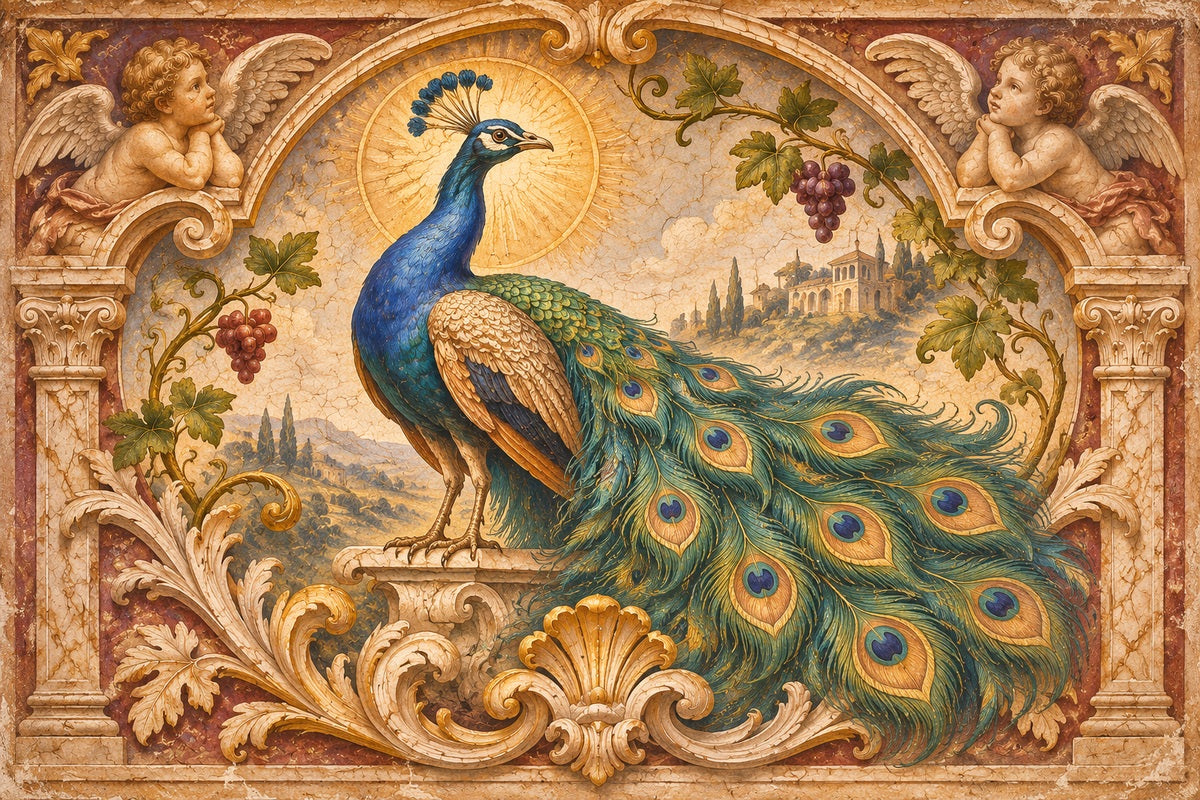
The motif and meaning of the peacock, a sacred being that symbolizes wealth and prosperity

While not as mainstream a motif in silver jewelry as skulls or crosses, peacocks have long been known as a popular motif in antique jewelry and beyond.
While a whole peacock is rare, it is not uncommon to find accessories made from a single tail feather.

Peacock Feathers Symbolize Wealth and Prosperity
Because a peacock's male tail feathers create such a magnificent impression when fanned out, the peacock is considered a symbol of wealth and prosperity.
Originally native to India and Southeast Asia, its beautiful appearance likely led it to spread widely as a trade item, resulting in different associations in various places, though the image of "wealth and prosperity" is particularly strong.
However, the Smithsonian Museum explains that the symbolic meaning of the peacock varies by culture, representing power, strength, confidence, divinity, and more.
It was also admired in 19th-century Aestheticism (Aesthetic movement) design.
It is said that the first peacock to enter Japan was presented to Empress Suiko in 598.
Peacock Feathers with Eye-like Patterns
Because peacock feathers have eye-like markings (ocelli), they are sometimes treated as sacred eyes, such as the Hamsa (Hand of Fatima) or the Eye of Horus, when used as a motif.
In Greek mythology, it is said that Hera, the wife of Zeus, took pity on Argus (the hundred-eyed giant who watched Zeus's lovers) when he was beheaded by Hermes on Zeus's orders, and transferred Argus's eyes to the peacock's tail feathers.
Peacocks Symbolize Immortality and the Warding Off of Evil
Peacocks are believed to ward off evil and repel demons.
Some people may associate the peacock with divinity.
In India, the peacock, which casually eats venomous snakes, is worshipped as the goddess Mahamayuri in Buddhism, believed to purify the three poisons: greed, anger, and ignorance.
Some may know of the Mahamayuri Bodhisattva.
The Mahamayuri Bodhisattva is a Buddhist deity that personifies the power of the peacock to eat venomous snakes, eliminating people's attachments, hatred, and other poisons, and removing misfortune.
In Europe, the Peacock Symbolized Immortality and Indestructibility
In Rome, Pliny the Elder, who wrote natural history, recorded that peacock feathers regrow each year, leading them to be considered symbols of immortality and regeneration. In Christianity, Saint Augustine stated that "the flesh of a peacock does not rot," making it a symbol of indestructibility.
The Symbolic Meanings of Peacock Motifs Vary by Culture
Peacocks have been regarded as sacred birds and symbols of good fortune around the world. However, their meanings vary by region and religion. The following table compares their representative symbolism and historical backgrounds.
| Culture/Region | Symbolic Meaning | Origin/Historical Background |
|---|---|---|
| Ancient Greece and Rome | Divinity, symbol of Hera (Juno), watchful eyes | In Greek mythology, it is said that the goddess Hera transferred the eyes of the hundred-eyed giant Argus to the peacock's tail feathers. In Rome, it was associated with the goddess Juno. |
| Christianity and Byzantine Art | Immortality, regeneration, eternal life, paradise | The peacock's feather-regrowth property and ancient legends that its flesh does not decay became associated with immortality. It has also been used in church art and mosaic decorations. |
| India and Buddhism | Overcoming poison, warding off misfortune, repelling evil | The peacock's habit of eating venomous snakes and other poisonous creatures became associated with the power to repel poison and misfortune. In Buddhism, it is incorporated into the worship of the Mahamayuri Bodhisattva. |
| China | Virtue, love, official rank, authority | The peacock was considered a bird representing virtue and was used in the imperial court as a decoration indicating the status and authority of civil officials. |
| Japan | Wealth, prosperity, many descendants, good fortune, warding off misfortune | Peacocks with beautiful tail feathers were depicted in paintings and crafts as auspicious birds. They are also associated with the Mahamayuri Bodhisattva in Buddhism and serve as a symbol that wards off misfortune. |
| 19th-Century Britain | Beauty, elegance, decorative appeal | Favored by Aesthetic artists and designers, the peacock's vibrant feathers and eye-like patterns were incorporated into interior decorations and decorative arts. |
As such, while the peacock is known in Japan as an auspicious bird that brings wealth and prosperity, it has been associated with the goddess Hera in Greek mythology, immortality and regeneration in Christian art, and warding off misfortune in Buddhism.
The peacock with its beautiful tail feathers is a decorative motif that has been given different meanings in various cultures and faiths.

Summary | The Meanings and Symbolism of the Peacock Motif
Because of its beautiful tail feathers and magnificent appearance, the peacock has been regarded as a sacred bird and a symbol of good fortune around the world.
In ancient Greece and Rome, it was associated with the goddess Hera (Juno), while in Christian art, it was depicted as a symbol of immortality, regeneration, and eternal life.
In India and Buddhism, the peacock's power to repel poison and misfortune became associated with the worship of the Mahamayuri Bodhisattva, while in Japan, it has been incorporated into paintings and crafts as a motif representing wealth, prosperity, and good fortune.
Thus, while the peacock carries different meanings in various cultures and religions, its distinctive tail feathers and graceful appearance have allowed it to be passed down from antiquity to the present day as a decorative motif expressing people's faith and wishes.


