
The Meaning and Origin of the Griffin: A Legendary Motif Symbolizing Courage and Protection
What Is a Griffin?

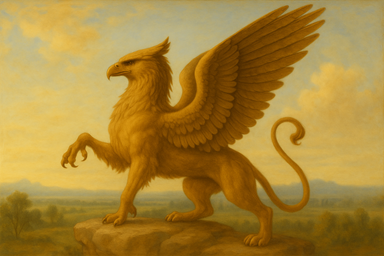
A griffin (Griffin) is a mythical creature with the upper body of an eagle and the lower body of a lion.
Combining the king of the skies—the eagle—and the king of the earth—the lion—it has been revered since ancient times as the "ultimate guardian."
The Origins and History of the Griffin
Ancient Persia and Mesopotamia
Images of griffins can be found in artworks dating back to around 3000 BCE.
They were believed to guard treasures and temples.
In ancient Greek mythology, they appeared as guardians of gold and were also considered messengers of Apollo and Zeus.
In medieval Europe, they were widely used in the coats of arms of knights and nobles, becoming symbols of "courage," "loyalty," and "protection."
Even today, the griffin is used in the coat of arms of the Swedish province of Södermanland.
While there are several theories about its origins, one suggests it originated in the Zagros Mountains and the Iranian Plateau, where lions were once abundant.
It appears that with the westward expansion of the Achaemenid Empire, it reached the Balkan Peninsula around the 5th century BCE.
What the Griffin Symbolizes
Protection and defense—the power to never let anything precious be taken away
- Sovereignty and authority—dominance over both heaven and earth
- Courage and loyalty—absolute devotion to companions and lords
- Harmony—the fusion of the celestial (eagle) and the earthly (lion)
Griffins are fundamentally considered sacred beasts symbolizing nobility and the bearing of a king, but they have also been treated with a demonic connotation in some contexts.
In some Christian interpretations, "hybrid creatures of beasts and birds" were viewed as disrupting the divine order of creation and were sometimes regarded as symbols of heresy and the demonic.
Particularly from the Renaissance onward, they have sometimes been depicted as "monsters that test the human soul" or "symbols of greed."
As mentioned above, the griffin originated in Persia and was a motif that predated Christianity; therefore, in the Christian context, it was viewed differently because of its pagan origins.
However, the design featuring an eagle's head and four lion legs was so popular that it became widely adopted.
The "Guardian of Chastity" in Medieval European Fables
In some medieval tales and bestiaries (collections of fables about animals), the griffin is depicted as a symbol of monogamy, never changing its mate throughout its life.
Because of this characteristic, it was sometimes used in wedding decorations and the coats of arms of noblewomen as a guardian of a woman's purity and chastity.
For example, it was sometimes carved into castle gates or treasure chests as a protector of newlywed women.

Summary
The griffin is a symbol of courage and protection that has been loved from ancient times to the present day, and due to its powerful form and symbolism, it is frequently used in the design of jewelry and metalwork.
Loved as a motif that gives the wearer a sense of "strength," "protection," and "nobility," it stands out beautifully in substantial metalwork and heraldic designs.