
Meaning and Origins of the Unicorn | The History of the Mythical Beast Symbolizing Purity, Protection, and Sovereignty
What Is a Unicorn? A Mythical Creature Symbolizing Purity, Nobility, and Protection

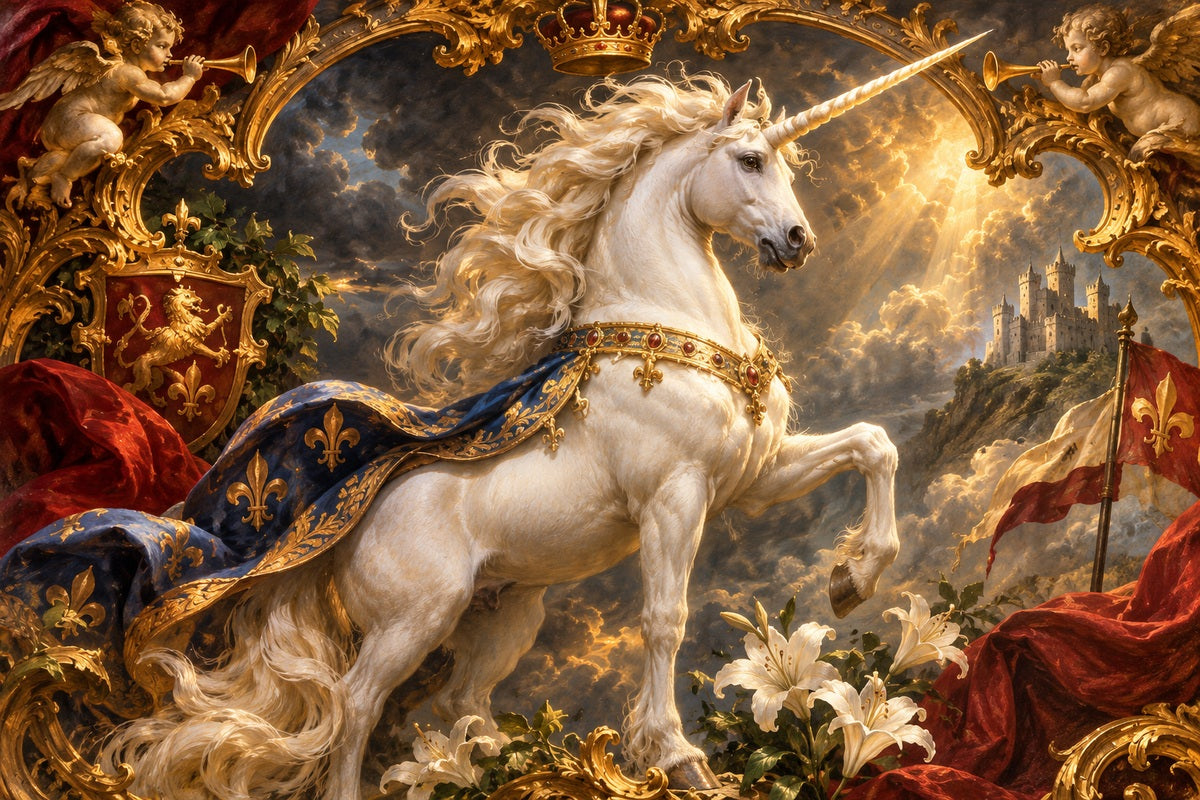
A unicorn (Unicorn) is a legendary animal with a single long horn on its forehead.
Today, it is known for its beautiful form as a white horse with a horn, but ancient and medieval texts also feature unicorns resembling wild donkeys or goats.
In medieval Europe, the unicorn was described as an animal with great power that would only yield to a pure maiden, and it was incorporated into Christian symbolism and aristocratic decorations.
Furthermore, its horn was believed to have the power to purify poison, and it has a history of being highly prized by royalty and nobility as a valuable item.
The representative meanings associated with the unicorn are as follows.
- Purity and Chastity: Derived from the medieval legend that it would only submit to a pure maiden.
- Sacredness: Depicted as an animal symbolizing Christ in Christian art.
- Protection and Purification: Derived from the legend that its horn had the power to eliminate poison.
- Nobility and Royalty: Adopted into the coat of arms of the Scottish royal family.
- Love and Marriage: A symbol in late medieval tapestries and aristocratic culture.
- Rarity and Specialness: Its characteristic as a mythical creature that cannot be easily captured.
These meanings have developed through ancient descriptions of animals, medieval legends, religious art, royal coats of arms, and more.
The Origins of the Unicorn | A One-Horned Creature Appearing in Ancient Greek Records

The history of the unicorn appearing in Western literature dates back to ancient Greece.
Particularly important are the descriptions by Ctesias, a Greek physician and historian of the 4th century BCE.
The Indian Unicorn Recorded by Ctesias
Ctesias wrote that there existed an animal in India resembling a wild donkey with a single horn.
This animal is described as a wild animal, unlike the unicorn resembling a modern white horse.
Later, Aristotle and the ancient Roman naturalist Pliny also mentioned the unicorn.
These ancient records became the background for the unicorn legends told in later Europe.
Why Was the Unicorn Depicted as a One-Horned Animal?
It is believed that ancient descriptions of unicorns included accounts of real animals.
There is a theory that one-horned animals such as the Indian rhinoceros influenced the image of the legendary unicorn as they spread to distant regions.
Meanwhile, in medieval Europe, religious meanings and supernatural abilities were added to the characteristics of real animals, developing into the form of the unicorn known today.
Why the Unicorn Became a Symbol of Purity in Medieval Europe
The background of the unicorn becoming a symbol of purity and chastity lies in the animal fables that spread in medieval Europe.
A representative example is the allegorical book about animals, "Physiologus," which was established in late antiquity.
The Unicorn That Can Only Be Captured by a Maiden
In medieval legends, the unicorn was considered an extremely strong animal that could not be captured by ordinary hunters.
However, it is said that when it comes before a pure maiden, it changes its attitude, approaches her, and rests its head on her lap.
Hunters would take advantage of this nature to capture the unicorn, which had become docile in the maiden's presence.
Through this legend, the unicorn became an animal symbolizing purity and chastity.
The Relationship Between the Unicorn, the Virgin Mary, and Christ
In medieval Christian art, religious meaning was given to the story of the unicorn being captured by a maiden.
In this interpretation, the unicorn symbolizes Christ, and the pure maiden symbolizes the Virgin Mary.
The image of the powerful unicorn becoming docile before the maiden was linked to the mystery of the Incarnation, in which Christ was born as a human.
For this reason, some works depicting the unicorn and the maiden together were created as religious iconography expressing Christian faith.
The Meaning of the Unicorn's Horn | The Legend of Purifying Poison and Protecting the Body
The single horn, a characteristic of the unicorn, was believed to have special powers.
In medieval Europe, legends spread that the unicorn's horn could eliminate poison and purify water.
The Unicorn Purifying Water with Its Horn
In medieval legends, there is a story of a unicorn dipping its horn into water contaminated by poison and purifying the water.
This scene is also depicted in the "Unicorn Tapestries" held by the Metropolitan Museum of Art in New York.
It depicts the unicorn dipping its horn into a spring, with surrounding animals gathering to drink the water.
In religious interpretations, the water contaminated by poison symbolized a world full of sin, and the purification by the unicorn symbolized salvation by Christ.
The Unicorn Horn Prized by Royalty and Nobility
In Europe, items believed to be unicorn horns were traded as valuable treasures.
This was because royalty and nobility believed that the horn had the power to detect poison or neutralize its effects.
Among the items actually prized as "unicorn horns" was the long tusk of the narwhal, a whale living in the Arctic Ocean.
The narwhal tusk is long and twisted, and in medieval Europe, it was sometimes treated as the horn of the legendary unicorn.
Its value was extremely high, and it was collected as a treasure of kings and nobles, as well as being placed in church treasuries.
From this history, the unicorn horn has become an important design symbolizing protection, purification, and mystical power.

Unicorns Depicted in Medieval European Art
Unicorns appeared widely in medieval European manuscripts, tapestries, and crafts.
Among them, representative works are France's "The Lady and the Unicorn" and the "Unicorn Tapestries" held in New York.
"The Lady and the Unicorn" | A Tapestry Representing the Five Senses and Court Culture
"The Lady and the Unicorn (La Dame à la licorne)" is a six-panel tapestry created around 1500.
It is currently held at the Musée de Cluny – Musée du Moyen Âge in Paris, France.
The work depicts a single lady as the center, along with a unicorn, a lion, and various animals and plants.
Five of the six panels express the five human senses.
- Sight: A scene where the unicorn's form is reflected in the mirror held by the lady.
- Hearing: A scene where the lady plays a musical instrument.
- Smell: A scene where the lady makes a flower crown.
- Taste: A scene where the lady takes a sweet.
- Touch: A scene where the lady touches the unicorn's horn.
The remaining panel bears words meaning "My only desire," and its interpretation is still a subject of art history research today.
This work shows that the unicorn was incorporated into art expressing not only purity and religious symbolism, but also aristocratic culture and human senses.
"The Unicorn Tapestries" | A Series Depicting Hunting and Rebirth
"The Unicorn Tapestries" is a seven-panel work created around 1495–1505.
It is currently held at the Metropolitan Museum of Art's Cloisters branch in New York.
This series depicts scenes such as hunters cornering a unicorn, purifying water, and being captured by a maiden.
One of the most famous works is "The Unicorn in Captivity," which depicts a unicorn resting in a garden.
The unicorn is tied to a pomegranate tree with a golden chain and sits in a garden surrounded by flowers.
This work layers meanings such as the resurrection of Christ and love united through marriage.
Comparing Two Representative Unicorn Tapestries
| Comparison Item | The Lady and the Unicorn | The Unicorn Tapestries |
|---|---|---|
| Production Period | Around 1500 | Around 1495–1505 |
| Number of Pieces | Six-panel set | Seven-panel set |
| Main Subject | The Lady and the Five Senses | The Hunting and Capture of the Unicorn |
| Symbolic Meaning | The Five Senses, Love, Court Culture | Purity, Christ, Love, Marriage |
| Current Location | Musée de Cluny – Musée du Moyen Âge (Paris) | Metropolitan Museum of Art (New York) |
Why the Unicorn Became a Symbol of Royalty and Nobility
The unicorn was used not only to represent purity and sacredness but also as an emblem of royal authority.
A representative example is the coat of arms of the Scottish royal family.
The Unicorn of the Scottish Royal Family
The unicorn is known as an iconic animal of Scotland and has long been used in the royal family's coat of arms.
In the coat of arms of the Scottish royal family, the unicorn is depicted as an animal supporting the shield.
Particularly distinctive is its form with a crown-like ring around its neck and a chain wrapped around its body.
According to the official explanation of the British royal family, this chain represents that the extremely strong unicorn is under the king's control.
The king's authority was expressed through the image of subduing a powerful and difficult-to-capture mythical creature.
The Lion of England and the Unicorn of Scotland
When King James VI of Scotland ascended as King James I of England in 1603, the symbols of the two kingdoms began to be combined.
Even in the current coat of arms of the British royal family, a lion representing England is placed on one side, and a unicorn representing Scotland is placed on the other.
These two animals have become important heraldic motifs representing royalty and the history of the nation.
Unicorns Used in Gold Coins and Adornments
In Scotland, the unicorn was used not only in the royal family's coat of arms but also on gold coins.
During the reign of James III in the late 15th century, gold coins engraved with the form of a unicorn were issued.
Furthermore, during the reign of James IV, there are records of hanging a golden unicorn from a golden chain and presenting it to court people and foreign visitors.
This also shows that the unicorn was used as an adornment to indicate the authority and formality of the royal family.
How the Form of the Unicorn Changed Over Time
Today, when people think of a unicorn, many probably imagine a white horse with a single long horn.
However, unicorns in ancient and medieval times were depicted in forms different from today.
Design Characteristics Seen in Medieval Unicorns
- A Single Long Horn: A horn extending forward from the forehead. In late medieval art, it is also depicted in a twisted shape.
- Goat-like Chin Beard: A characteristic seen in medieval manuscripts and tapestries.
- Split Hooves: A form with hooves like a goat rather than a horse.
- Long Tail: In addition to a horse's tail, it is sometimes depicted with a tufted tail reminiscent of a lion.
- White Body: White unicorns are also depicted numerous times in medieval art.
These characteristics show that the unicorn was depicted not simply as a horse with a horn, but as a mythical creature combining the characteristics of multiple animals.
Comparing Ancient, Medieval, and Modern Unicorns
| Period | Form Characteristics | Representative Meaning and Image |
|---|---|---|
| Ancient | A one-horned animal resembling a wild donkey | A rare animal believed to live in distant lands |
| Medieval | Horse- and goat-like body, chin beard, long horn | Purity, Christ, purification, love |
| Early Modern Heraldry | Form with a horn, chin beard, tufted tail, chain, etc. | Royalty, authority, nobility |
| Modern | Generally a form with a single horn on a white horse | Purity, mystery, fantastical beauty |
The Meaning of Unicorn Motifs Used in Accessories
Even today, the unicorn is a popular decorative motif used in pendants, rings, brooches, and more.
Its appeal lies in its unique form with a single horn and the symbolic meanings it has been given over a long history.
Meanings such as medieval purity and love, nobility seen in royal coats of arms, and protection derived from the legends of the horn are also incorporated into accessory designs.
Representative Accessory Designs Using Unicorns
- Unicorn Pendant: A design that three-dimensionally expresses the full body or head of a one-horned unicorn.
- Unicorn Ring: A design with the horn, mane, and facial contours engraved.
- Heraldic-Style Accessory: A design combining a shield, crown, chain, etc., with a unicorn.
- Gothic-Style Ornament: A design placing a unicorn within plant patterns and decorative frames.
- Jewelry Using Gemstones: A design adding gemstones or enamel decorations to the form of a unicorn.
In fact, brooches based on medieval unicorn tapestries are also produced at the Metropolitan Museum of Art's museum shop.
The forms of unicorns seen in old tapestries and royal coats of arms are carried over into today's accessories.

Summary | The History of the Unicorn Becoming a Symbol of Purity and Nobility
The unicorn is a mythical creature that developed from records of one-horned creatures appearing in ancient Greek texts to medieval European religious art and royal coats of arms.
In the Middle Ages, legends spread that it would only yield to a pure maiden, and it became a symbol of purity, chastity, and Christ.
Furthermore, the unicorn's horn was believed to have the power to purify poison and was highly prized among royalty and nobility.
"The Lady and the Unicorn" and "The Unicorn Tapestries" express meanings such as purity, love, marriage, and faith associated with the unicorn.
Furthermore, in the coat of arms of the Scottish royal family, the unicorn was used as an important animal representing strength, nobility, and royal authority.
The unicorns used in today's accessories also carry symbolic meanings derived from these myths and legends, as well as medieval European decorative culture.