

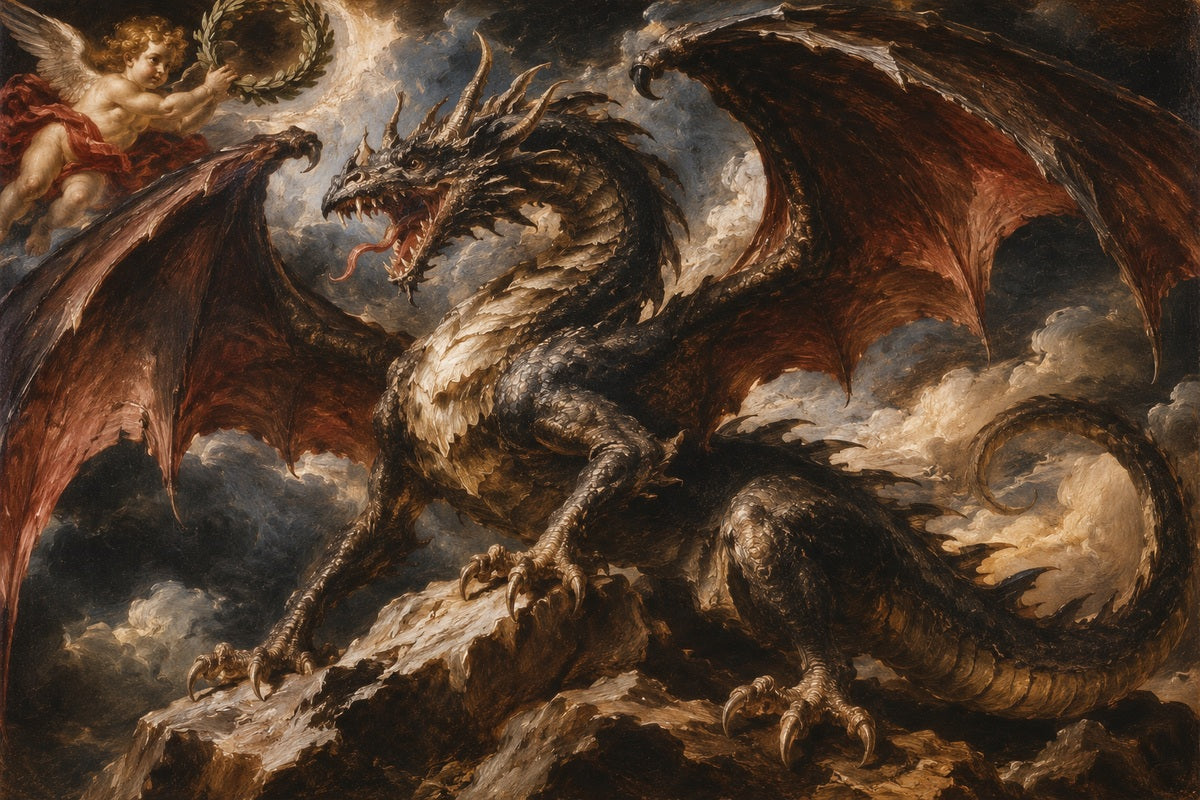
Meaning and Origins of Dragon Motifs: Differing Symbolism and Decorative Histories in the East and West
Ryu and dragons are mythical creatures that have appeared in myths and legends around the world since ancient times and have been used in decorations such as accessories, coats of arms, architecture, and metalwork.
Their meanings differ greatly between the East and the West. In the West, they are often depicted as evil forces or formidable enemies, while in the East, they have been revered as sacred beings that control water and rain.
However, in the West, there are also dragons, such as the Red Dragon of Wales, that represent national pride and authority.
In this article, we will explain in detail the differences in meaning between dragons and ryu, the history of myths and coats of arms, the dragon of Chinese emperors, the Japanese belief in water deities, and dragon decorations used in silver accessories.
What Do Ryu and Dragon Motifs Mean? Symbols of Power, Protection, and Authority
Ryu and dragons have been depicted as beings with immense power.
Their powerful forms, featuring large claws and fangs, long bodies, and sharp eyes, have served as subjects for myths and art around the world.
Their representative meanings are as follows.
- Power and Majesty: A symbol of a mythical beast with power beyond that of humans.
- Monarchy and Authority: Historically used in the emblems of Chinese emperors and the coat of arms of Wales.
- Protection: Historically revered as sacred beings in Japan and China and depicted as protectors in Buddhism.
- Rain, Water, and Abundance: A meaning associated with rain clouds, rivers, and the water necessary for agriculture in East Asia.
- Threat and Evil Forces: A meaning used to symbolize demons and sin in medieval Christian art.
- Victory and Courage: A meaning expressed through heroes and saints who defeated powerful dragons.
These differences in meaning are also reflected in how dragons are depicted.
Differences Between Eastern Ryu and Western Dragons
The differences between ryu and dragons are not merely in their appearance.
Eastern ryu are known as sacred beings that control clouds, rain, and water, while Western dragons often appear as terrifying monsters with wings and claws.
| Comparison Item | Eastern Ryu | Western Dragon |
|---|---|---|
| Representative Meanings | Sacredness, protection, rain, water, imperial authority | Threat, evil forces, immense power, monarchy |
| Physical Characteristics | Snake-like long body, horns, claws, scales | Reptile-like body, sharp claws, wings, etc. |
| Relationship with Nature | Rain clouds, rivers, the sea, the power of water | Appears in stories involving fire, wilderness, caves, etc. |
| Representative Art | Imperial dragon robes, folding screens, ink wash paintings, sword fittings | Saint George slaying the dragon, coats of arms, sculptures |
| Decorative Features | Long, sinuous body, combined with clouds, waves, and a sacred jewel | Wings, fangs, claws, tail, and fighting poses are emphasized |
Even in modern accessories, Eastern ryu are often depicted with long, sinuous bodies, while Western dragons feature three-dimensional designs that emphasize wings and sharp claws.
Why Western Dragons Were Depicted as Evil Beings

In medieval European Christian art, dragons appeared as symbols of demons, sin, and evil forces.
Dragons with massive bodies and sharp fangs were depicted in stories as terrifying monsters that threatened people.
Saint George Slaying the Dragon
One of the most famous scenes featuring dragons in Western art is Saint George slaying the dragon.
Saint George is a Christian saint, and legend tells of him as a hero who saved a town by slaying a dragon that tormented its people.
This story of slaying the dragon is also included in the 13th-century collection of saintly lives, The Golden Legend.
In paintings and sculptures, Saint George is frequently depicted riding a horse and piercing the dragon with a spear.
The Metropolitan Museum of Art houses a wooden sculpture of Saint George and the Dragon, created in southern Germany around 1460–1470.
In this work, Saint George holds down the neck of the dragon he has defeated with his foot.
Defeating the Dragon Became a Symbol of Victory and Courage
In medieval Europe, scenes of defeating the dragon were depicted as the victory of good over evil forces.
By defeating a monster that humans could not easily overcome, the courage and power of faith of the saint were demonstrated.
Dragons were depicted as beings of overwhelming power, and their strength made the stories of slaying the dragon even more memorable.
Archangel Michael and the Dragon
Archangel Michael also appears in religious imagery depicting the defeat of dragons.
The Book of Revelation describes Michael and his angels fighting the dragon.
In medieval religious art, dragons were depicted as symbols of evil, and Michael was shown defeating them in victory.
This subject was also used in religious metalwork, and the Metropolitan Museum of Art houses the head of a 13th-century French bishop's staff decorated with Michael defeating a dragon.

The Red Dragon of Wales | A Dragon Symbolizing a Nation and Monarchy
In addition to its meaning as an evil monster, the Western dragon also plays a role as a symbol of a nation and monarchy.
A prime example is the red dragon depicted on the flag of Wales.
The Red Dragon of Wales, “Y Ddraig Goch”
The Red Dragon of Wales is called “Y Ddraig Goch” in Welsh.
The flag featuring a red dragon centered on a white and green background is known as a representative symbol of Wales.
Medieval Welsh legends feature a story in which a red dragon and a white dragon fight, and the red dragon emerges victorious.
This red dragon became a symbol representing the people of Wales.
The History of the Dragon in Heraldry
According to the National Museum of Wales, medieval Welsh poets praised brave leaders by comparing them to dragons.
The red dragon was also used in heraldry during the Tudor dynasty in the 15th and 16th centuries and was later officially adopted as the flag of Wales.
The current flag featuring the red dragon was officially recognized in 1959.
In this way, dragons have also been used in the West as important heraldic motifs representing strength and national pride.
The Meaning of the Chinese Dragon | A Sacred Beast Representing Rain, Abundance, and Imperial Authority
Chinese dragons have long been revered as sacred beings and believed to control rain, water, and the forces of nature.
Their forms have been incorporated into imperial clothing, palaces, and crafts, becoming one of the representative decorations of Chinese art.
The Dragon That Calls for Rain and Brings Abundant Harvests
In China, the dragon is known as a sacred beast that summons clouds and brings rain.
Because it brings the rain essential for growing crops, the dragon has been associated with the blessings of water and abundance.
The dragon flying through the clouds and moving across the waves is repeatedly depicted in Chinese paintings and ceramics.
The Dragon That Became a Symbol of Chinese Emperors
The dragon was also an important symbol of the authority of Chinese emperors.
Imperial clothing featured dragon-embroidered “longpao” (dragon robes), and dragons were also depicted on decorations related to palaces and ceremonies.
The 18th-century Qing dynasty ceremonial robes in the Metropolitan Museum of Art feature five-clawed dragons and patterns representing imperial authority.
Clouds, waves, mountains, and other elements are depicted around the dragon, symbolizing the emperor's authority to rule the world.
What Does a Five-Clawed Dragon Mean?
One of the most famous aspects of Chinese dragon decoration is the difference in the number of claws.
In Qing dynasty court clothing, the five-clawed dragon was closely associated with the authority of the emperor and imperial family.
The dragon designs and colors used in clothing were determined by rank, and imperial robes in particular were made under strict regulations.
Official robes and decorations featuring four-clawed dragons also remain.
These differences in the number of claws indicate that Chinese dragons were not merely decorative but were also used as designs representing rank and authority.
The Dragon Combined with a Sacred Jewel, Clouds, and Waves
In Chinese dragon patterns, the dragon's form is sometimes combined with other decorations.
- Clouds: A decoration representing the dragon's power to travel through the sky and call for rain.
- Waves: Representing the dragon's relationship with water and used in clothing and vessel decorations.
- Sacred Jewel: A spherical decoration that the dragon chases or holds.
- Mountains: A decoration representing the natural world together with water and clouds.
The sinuous design combining the dragon's long body with clouds and waves is a characteristic form of Eastern dragon patterns.
The Meaning of Japanese Dragon Motifs | Water Deities, Protection, and Strength
Japanese dragons developed within their own art and beliefs, rooted in the dragon culture that spread from China through the Korean Peninsula.
The dragon's form is depicted in temple and shrine decorations, ink wash paintings, folding screens, kimonos, and sword fittings.
The Dragon Revered as a Water Deity
In Japan, dragons have also been revered as beings that control rain and water.
During droughts, they were sometimes the object of prayers for rain, while during heavy rains, people prayed to them to make the rain stop.
The Tokyo National Museum introduces a statue of a dragon by the Edo-period Buddhist sculptor Enku, explaining its connection to prayers for rain or to stop the rain.
The Dragon Protecting Buddhism
In Japan, dragons have also been depicted as protectors of Buddhism.
In the Buddhist belief in dragon kings, dragons are sacred beings associated with water and also hold the role of protecting the Buddhist teachings.
Based on this belief, dragons were also incorporated into temple carvings and religious art.
Dragons and Rain Clouds in Ink Wash Paintings
Dragons are also an important subject in Japanese painting.
The Tokyo National Museum houses the Chinese Southern Song dynasty scroll “Five Dragons,” which depicts dragons integrated with clouds and flowing water.
These Chinese dragon paintings also influenced Japan, and painters from the Kano school and others passed down the expression of depicting dragons together with clouds and rain.
The “Twin Dragons” painted by Kano Tan'yu in 1666 also depicts dragons moving powerfully through rain clouds.
Dragons Used in Japanese Metalwork | Exquisite Metalwork Remaining on Sword Tsubas
Dragons are important decorative motifs not only in paintings and architecture but also in Japanese metalwork.
In particular, sword fittings from the Edo period preserve works exquisitely carved with dragon heads, scales, claws, and long bodies.
Sword Tsubas Carved with Dragons Moving Through Waves
The Metropolitan Museum of Art houses a 19th-century Japanese sword tsuba (handguard) featuring a dragon in waves.
In this work, a dragon emerging from the waves is expressed in three-dimensional carving, and parts of the dragon are adorned with gold-inlaid cloth-patterned metalwork.
Another tsuba depicting a golden dragon moving between clouds and waves is also housed there, revealing precise craftsmanship combining metals such as red copper, gold, and copper.
Sword fittings were not only practical items but also decorative pieces that concentrated the techniques of metal carving.
Characteristic Forms Used in Dragon Metalwork
When carving a dragon in metal, the characteristic forms found on the dragon's body become the center of the decoration.
- Dragon Head: A powerful form emphasizing the horns, fangs, whiskers, and eyes.
- Scales: Representing the patterns covering the dragon's body with fine carving.
- Claws: Parts that emphasize sharpness and strength.
- Long Body: A sinuous form that runs along the surface of the metal.
- Clouds and Waves: Decorations expressing the natural forces surrounding the dragon.
- Sacred Jewel: A spherical decoration combined near the dragon's mouth or claws.
Because dragons can combine curves with fine scale decorations, they are also known as a subject that expresses the three-dimensionality and shading of metal carving.
Comparing the Meanings and Uses of Ryu and Dragon Motifs
Comparing the meanings of ryu and dragons through representative cultural and decorative uses reveals the following.
| Culture and Region | Representative Meanings | Representative Decorations and Uses |
|---|---|---|
| Medieval Europe | Threat, evil forces, victory through slaying the dragon | Sculptures of Saint George, religious paintings |
| Wales | National pride, courage, authority | Red dragon flag, coat of arms |
| China | Rain, water, abundance, imperial authority | Dragon robes, palace decorations, lacquerware, ceramics |
| Japan | Water deity, Buddhist protection, strength | Temple and shrine carvings, ink wash paintings, sword fittings |
Meanings Imbued in Ryu and Dragon Motifs in Accessories
Ryu and dragons remain popular decorative motifs used in rings, pendants, bracelets, and other items today.
In metal accessories in particular, sharp claws and fangs, three-dimensional scales, and long, sinuous bodies are characteristic design features.
Accessories Featuring Eastern Ryu
Accessories featuring Eastern ryu often combine a long, sinuous body with clouds and waves.
These decorations incorporate the meaning of a sacred being that controls water and rain, as well as symbols of strength and protection.
Accessories Featuring Western Dragons
Accessories featuring Western dragons often emphasize wings, claws, and fangs.
Designs include those expressing the power of a monster and those based on dragons appearing in coats of arms.
Silver Accessories with Dragon Carvings
The dragon carvings found in Japanese sword fittings share similarities with modern hand-engraved metalwork.
By finely carving the dragon's scales, whiskers, and claws and combining them with clouds and waves, powerful forms can be expressed even on small metal surfaces.
Dragon metalwork applied to silver accessories and metal products is one of the animal decorations passed down since ancient times.
At IMULTA, decorations featuring dragons, plants, and other motifs are created by hand-engraving patterns into metal surfaces.

Summary | Ryu and Dragons Are Historic Motifs Representing Immense Power and Authority
Ryu and dragons are mythical creatures that have been incorporated into decorative art since ancient times, carrying different meanings around the world.
In medieval Europe, they represented evil and threats, while the images of Saint George and Archangel Michael defeating dragons became symbols of victory and faith.
In Wales, the red dragon became a symbol of the nation, while in China, it was revered as a sacred beast that controlled rain and water and used as an important pattern representing imperial authority.
In Japan, dragons were also revered as water deities and protectors of Buddhism and have been depicted numerous times in ink wash paintings, temple and shrine architecture, and sword fittings.
The dragons and dragons used in modern rings, pendants, and metal carvings also carry symbolic meanings derived from these myths, beliefs, monarchy, and traditional crafts.


