

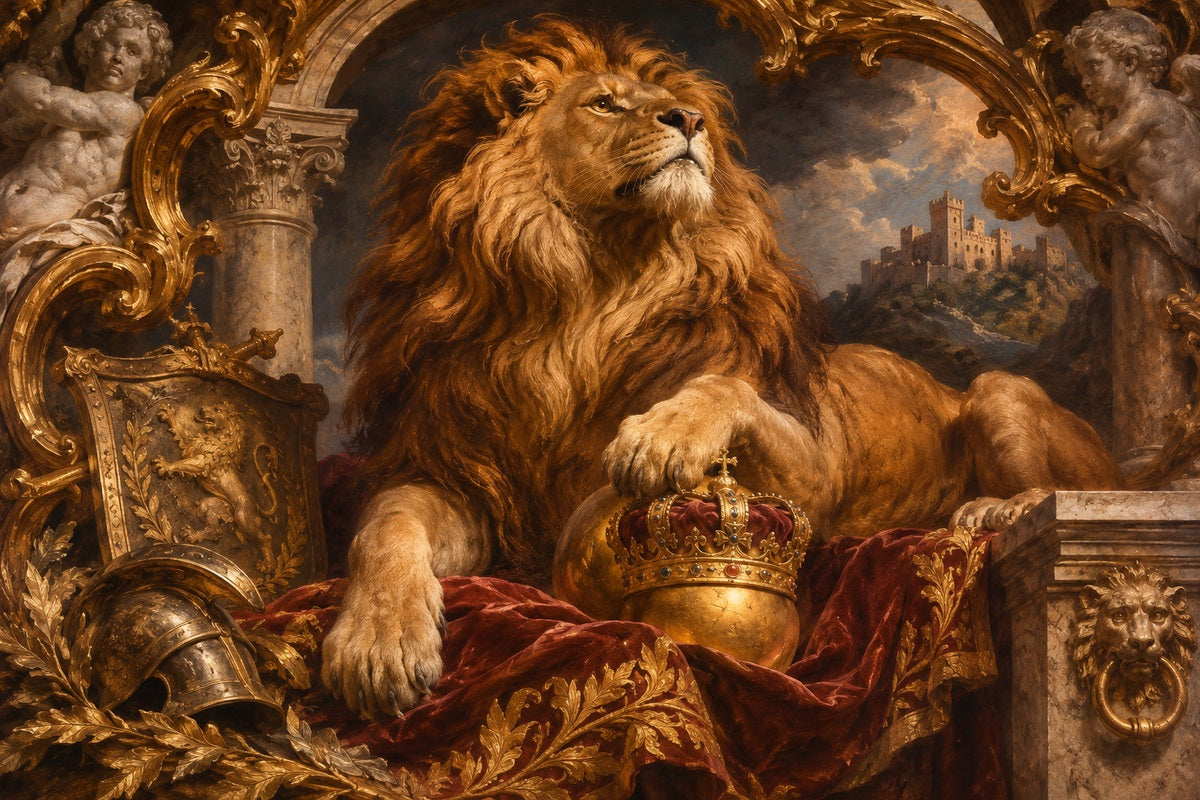
Meaning and Origins of the Lion Motif: A History of Ornamentation Symbolizing Power, Sovereignty, and Protection
What Does the Lion Motif Mean? A Symbol of Power, Royalty, Courage, and Protection

The lion is an animal motif that has been widely used in accessories, heraldry, sculpture, and architectural decoration from ancient times to the present day.
Its powerful form, sharp fangs, and magnificent mane have inspired both fear and respect in people.
In particular, when depicting kings or heroes, the strength and majesty of the lion carried significant meaning. It has also been portrayed as a guardian at the entrances of buildings, warding off danger.
The primary meanings associated with the lion motif are as follows:
- Power and Strength: A symbol born from its ability to overpower prey and its imposing appearance.
- Royalty and Majesty: Decoration used to represent the power of kings and rulers.
- Courage: The image of heroes and knights facing off against dangerous lions.
- Victory: Expressing triumph over formidable power by defeating or taming a lion.
- Protection and Warding Off Evil: Used as a guardian of temples and building entrances.
- Vigilance and Watchfulness: Derived from medieval animal fables in which it was believed that lions kept their eyes open even while asleep.
A lion can represent the power of a king, or it can appear as a formidable foe that a hero must defeat. Understanding this difference reveals why lions were used in ancient accessories and sculptures.
Why the Lion Became a Symbol of Power and Strength
The lion has been treated as a special animal because of its appearance and strength.
Its large body, sharp claws and fangs, and the mane of the male lion convey a sense of majesty unlike that of other animals.
In ancient art, these features were used to represent the authority of kings and rulers.
A Symbol of Royalty and Protection in Ancient Egypt
In ancient Egypt, the lion was treated as an animal symbolizing the power of the king.
Lion statues also served to guard sacred places.
The Metropolitan Museum of Art houses a plaster model of a lion's head made around 400–300 BCE.
This model was used to create lion-shaped water spouts that channeled rainwater from temple roofs.
The museum explains that this lion figure served as a guardian, preventing evil forces from entering sacred spaces through the water spout.
In this way, lions in ancient Egypt not only represented the power of the king but were also incorporated into architecture as symbols guarding temples.
Defeating a Lion as Proof of Formidable Power
Lions have not only symbolized rulers but have also been depicted as formidable enemies that heroes must defeat.
By defeating a lion, a powerful animal, a person could be shown to possess extraordinary strength or courage.
This motif can be found in ancient heroic tales and religious traditions.
Hercules and the Nemean Lion | The Origin of the Lion's Pelt as a Hero's Symbol
One of the most famous heroes to defeat a lion is Hercules from Greek mythology.
Hercules had to complete twelve trials known as the Twelve Labors, the first of which was to slay the Nemean Lion.
Why Hercules Wore the Lion's Pelt
In mythology, the Nemean Lion is described as a terrifying monster that could not be harmed by ordinary weapons.
Hercules slew this lion and later used its pelt to protect himself.
In ancient Greek art, Hercules is frequently depicted wearing the lion's head as a helmet and draping the pelt over his shoulder.
The lion's pelt was both proof of his victory over a formidable foe and a distinctive attribute signifying Hercules' superhuman strength.
This image was passed down to later sculpture and painting, becoming so iconic that a lion's pelt alone is enough to identify Hercules.
Lions Also Featured in the Stories of David and Samson
Stories of defeating a lion to represent strength or courage are not limited to Greek mythology.
The Old Testament also features individuals who fight lions.
- David: In 1 Samuel 17, he recounts defeating a lion and a bear to protect his flock of sheep.
- Samson: In Judges 14, he is said to have torn apart a young lion with his bare hands when it attacked him.
In both stories, the lion appears as a formidable foe that cannot be easily defeated.
Because the lion itself is a symbol of power, the courage and extraordinary strength of the person who defeats it are made even more striking.

Why Lions Were Frequently Used in Medieval European Heraldry
The lion is one of the most iconic animal motifs in medieval European heraldry.
Heraldic designs were used to identify individuals, families, and groups, and were depicted on shields, banners, clothing, and seals.
Because lions were associated with strength, courage, and majesty, they were adopted into the heraldry of kings and nobles.
The Three Lions of the English Royal Family
One of the most famous examples of heraldry featuring lions is the three lions of the English royal family.
According to the Victoria and Albert Museum, lions were incorporated into the English royal coat of arms in the late 12th century.
The three lions are depicted walking with their right front paw raised and their faces turned toward the viewer.
In heraldry, this posture is known as "passant guardant."
Medieval lion motifs were used not only on shields and banners but also on pouches protecting seals attached to royal documents and on decorative cloths for horses.
How a Lion's Posture Changes Its Heraldic Design
Lions depicted in heraldry have specific terms to describe their postures.
For example, different terms are used for a lion standing on its hind legs and a lion walking on all four legs.
| Heraldic Term | Postural Characteristics | How to Distinguish |
|---|---|---|
| Rampant | Standing on hind legs | Standing with front legs raised |
| Passant | Walking | Walking with one front leg raised |
| Statant | Standing on all four legs | Standing with all four legs on the ground |
| Sejant | Sitting | Sitting with hind legs bent |
| Couchant | Lying down | Lying down with the body low |
| Guardant | Facing forward | Specifies the direction the face is turned in addition to the posture |
These terms are primarily used to distinguish a lion's posture and the direction it is facing.
Even with the same animal, different combinations of posture, orientation, color, and number of lions can create different heraldic designs.
Therefore, when viewing a lion in heraldry, paying attention not only to whether a lion is depicted but also to how it is portrayed can help reveal its distinctive features.
Lions Used in Royal Clothing | The Cloak of Roger II
Lions were incorporated not only into heraldic shields and banners but also into lavish clothing that symbolized royal authority.
A prime example is a cloak made for Roger II, the first king of the Kingdom of Sicily, between 1133 and 1134.
It is now housed in the Kunsthistorisches Museum in Vienna, Austria.
Two Lions Overpowering Camels
This cloak features two lions arranged symmetrically on either side of a central palm tree.
Each lion is depicted trampling a camel, and the cloak is adorned with lavish embroidery using gold thread and pearls.
Images of lions defeating other animals were used in the medieval Mediterranean world to symbolize royalty and superiority.
However, there are multiple interpretations of what the camels on this cloak specifically represent, and it cannot be concluded that they signify a particular people or nation.
Lions depicted on royal clothing were important decorations that visually expressed the power and majesty of the person wearing them.
The Meaning of the Winged Lion | The Symbol of Venice and Saint Mark
Among decorations featuring lions, the winged lion is a particularly distinctive motif.
A famous example is the "Winged Lion of Saint Mark" found in Venice, Italy.
Why Saint Mark Is Represented by a Lion
In Christianity, each of the four Gospel writers believed to have written the Gospels is assigned a symbolic figure.
The symbol of Saint Mark is the winged lion.
The National Gallery in London also explains that the winged lion is the symbol of Saint Mark and that Venice uses the motif as a symbol of the city.
The Heraldry of Venice and the Authority of the City
Saint Mark is the patron saint of Venice, and his symbol, the winged lion, also became a motif representing the authority of the Republic of Venice.
The winged lion has been used on city banners, seals, and architectural decorations.
It is also well known for holding a book with its front paws.
In this way, the lion became not only a powerful animal but also a motif that combined religious symbolism with the authority of the city.
Why the Lion Became a Symbol of Protection and Warding Off Evil
In addition to symbolizing royalty and courage, lions have also been used as guardians of buildings.
Their strength and fearsome appearance are associated with the idea of warding off dangerous beings trying to enter from outside.
Lions Placed at the Entrances of Temples and Buildings
Since ancient times, lion statues have been used to adorn temples, palaces, and city gates.
Lion carvings have also been placed at the entrances and bases of columns in medieval European church architecture.
For example, the Isabella Stewart Gardner Museum houses a stone lion carving made in Italy around 1200 that supported an architectural column.
By placing lions at the entrances of buildings, they could express strength and also serve as guardians.
Lion Door Knockers and Door Decorations
Lion heads have also been used for metal decorations such as door knockers attached to doors.
A lion's face with a wide-open mouth, sharp fangs, and an emphasized mane can impressively adorn the entrance to a building.
Such decorations incorporate the majesty and strength of the lion into their design.
Lion statues placed at entrances have also sometimes been given the meaning of warding off evil.

Medieval Folklore | Lions Were Believed to Sleep with Their Eyes Open
In medieval Europe, there were various beliefs about the habits of lions that differed from modern zoology.
One of these was that "lions sleep with their eyes open."
This belief is found in the ancient animal fable Physiologus and was passed down to later medieval Europe.
An Animal That Never Relaxes Its Vigilance Even While Asleep
The belief that lions keep their eyes open while asleep led to the interpretation of lions as beings that are always vigilant.
In medieval Christian interpretations, this quality was also associated with Christ, who watches over people.
There was also a belief that lion cubs are born dead and come to life through their father's breath and roar.
This story was interpreted as symbolizing the resurrection of Christ.
Of course, it has not been confirmed that real lions sleep with their eyes open or that they can bring their cubs back to life with a roar.
What is important is how people at the time understood the nature of lions and what meaning they attributed to their appearance.
The History of the Lion Motif in Accessories
Lions have long been used not only for large buildings and royal heraldry but also for small wearable accessories.
In fact, lion-shaped pendants and rings from before the common era are still housed in museums today.
Ancient Greek Lion-Shaped Pendants
The British Museum houses a gold lion-head pendant made around 450–400 BCE.
This pendant was made by working a gold sheet, and the face, mouth, and fangs are finely detailed.
The decorative ring can be used to attach it as a necklace, showing that lion heads were used as wearable accessories.
Ancient Etruscan Rings Engraved with Lions
In ancient Etruria on the Italian peninsula, lions were also incorporated into jewelry.
The Metropolitan Museum of Art houses a gold ring engraved with a lion from the early 5th century BCE.
The front of the ring features a lion sculpted in relief.
Such works confirm that lions were used not only for three-dimensional pendants but also for small carvings on rings.
Representative Forms of the Lion Motif
Decorations featuring lions range from those that depict the animal as it is to those that emphasize only some of its features.
- Lion Head: Decoration emphasizing the mane, fangs, and facial expression. Used for pendants, door hardware, and other items.
- Full-Body Lion: Depicts the lion standing, walking, or sitting. Used for rings, heraldry, and sculpture.
- Rampant Lion: Depicted standing on its hind legs. A common motif in medieval European heraldry.
- Winged Lion: A motif associated with religious symbolism. The winged lion of Saint Mark is a prime example.
- Lion Combined with Another Animal: Depicts a lion defeating another animal. Used in decorations symbolizing victory or superiority.
The appearance of lion decorations changes significantly depending on the facial expression and posture.
Comparing the Meanings and Uses of the Lion Motif
Over a long history, lions have been used in decorations with a variety of meanings.
The main cultures and uses can be summarized as follows:
| Culture/Period | Main Meaning | Representative Uses |
|---|---|---|
| Ancient Egypt | Royalty, power, protection | Temple carvings, amulets, decorations |
| Ancient Greece | Strength, heroic victory | Hercules iconography, gold pendants |
| Ancient Etruria | Used as a decorative motif | Gold rings engraved with lions |
| Medieval Europe | Courage, royalty, majesty, protection | Heraldry, banners, clothing, church carvings |
| Venice | Saint Mark, authority of the city | Winged lion, banners, seals, architectural decorations |
A common theme among lions is the association of their strength and majesty with human power, courage, and protection.

Summary | Why the Lion Motif Has Been Used for So Long
Because of their strength and imposing appearance, lions have been incorporated into art and decoration since ancient times to represent power, courage, victory, and protection.
In ancient Egypt, they were portrayed as guardians of royalty and sacred places, while in Greek mythology, they were depicted as formidable foes that the hero Hercules had to defeat.
In medieval Europe, they were used in the heraldry of kings and nobles and in lavish clothing, and in some cases, they were passed down as religious and civic symbols, such as the winged lion of Saint Mark.
Lions can also be seen on gold pendants and rings from before the common era, showing that they have long been a motif for wearable accessories.
The lion motif is a decoration with a long history that expresses both the strength of the animal itself and the aspiration for the authority and courage that people have associated with it.