

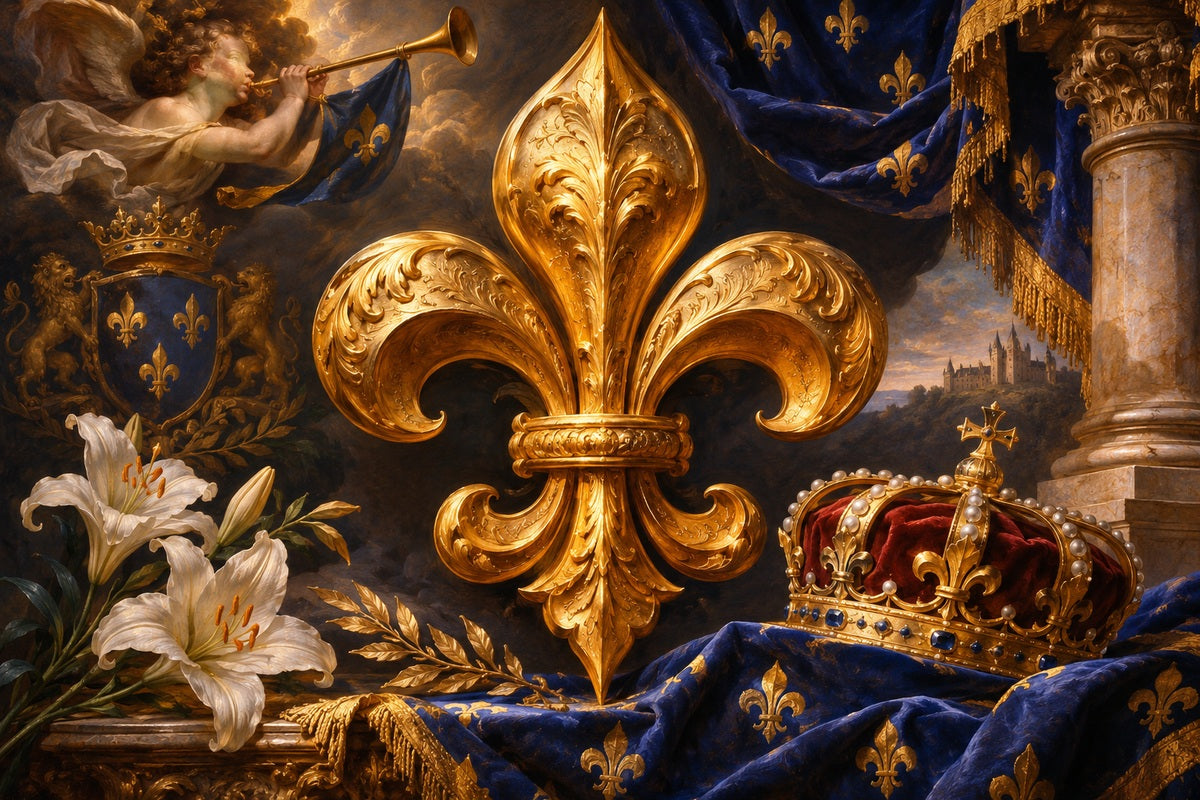
Meaning and Origins of the Lily (Fleur-de-lis) Motif | History of the Fleur-de-lis and Royal Heraldry
What Is the Lily (Fleur-de-lis) Motif? A Classic Silver Accessory Design

The fleur-de-lis is a classic motif known in silver accessories.
It is a design characterized by a pointed central petal and outward-spreading curves, used in rings, pendants, bracelets, wallet chains, and more.
In Japan, it is often called the "lily emblem" or "fleur," but its official name in French is fleur-de-lis (Fleur-de-lis).
This pattern was not created by modern accessory brands; it is a historic plant motif that has been used in the heraldry, clothing, architecture, and ornaments of European royalty and nobility since the Middle Ages.
It is particularly closely associated with the French royal family and is known as a symbol of royal authority, nobility, and faith.
The fleur-de-lis has several representative meanings, including the following:
- Royal Authority: Used as the emblem of the French royal family, it represented the king's status and right to rule.
- Nobility and Dignity: Symbolism derived from its incorporation into the clothing and ornaments of royalty and nobility.
- Purity and Innocence: Originating from the use of white lilies as a symbol of the Virgin Mary in Christian art.
- Faith: A motif representing the connection between medieval French royalty and Christianity.
- Tradition and Prestige: As an emblem with a long history, it continues to be used in various decorations today.
So why did a single flower become an emblem symbolizing royalty and continue to be passed down to modern silver accessories?
What Is the Fleur-de-lis? The Shape and Name of the Lily Emblem
Fleur-de-lis is a French term meaning "lily flower."
It is not a direct depiction of an actual lily flower, but rather a stylized, symmetrical design based on the shape of the flower.
The Distinctive Shape of the Lily Emblem
A typical fleur-de-lis has the following characteristics:
- Central Petal: A pointed shape extending upward.
- Side Petals: Shapes that spread outward with tips curving downward.
- Central Band: A section that crosses the three petals as if binding them together.
- Lower Stem: The part extending from beneath the petals, the shape of which varies by design.
Its decorative characteristic is the combination of a straight shape extending from the center and curves spreading to the left and right.
This symmetrical form fits easily into limited areas such as the front of a ring or a pendant, and is also incorporated into metalwork and three-dimensional ornaments.
Do "Fleur" and "Fleur-de-lis" Mean the Same Thing?
In Japanese silver accessories, the term "fleur" is widely used.
This term refers to lily emblem designs based on the fleur-de-lis.
It may also be sold under names such as "lily," "lily emblem," or "fleur-de-lis."
When researching historical names, knowing the term fleur-de-lis makes it easier to understand its connection to European heraldry and artworks.

Origins of the Lily Motif | From Ancient Plant Decoration to Medieval Europe
The history of lilies being used as decoration dates back to an era even earlier than medieval Europe.
Works depicting lily flowers also remain from the murals and crafts of the ancient Mediterranean world.
Lily Decorations of the Ancient Minoan Civilization
A representative example of ancient lily decoration is the mural of the Minoan civilization that flourished on the island of Crete in the Aegean Sea.
The Heraklion Archaeological Museum houses a "fresco of lilies" excavated from the Amnisos site around 1600–1500 BCE.
This mural depicts several white lilies.
Additionally, the mural known as the "Prince of Lilies," discovered at the Palace of Knossos, also features decorations using lilies.
The lilies of this era are plant decorations that express the actual form of the flower.
Although they differ in shape from the three-petaled emblem seen in modern silver accessories, it is clear that lilies have been incorporated into decorations since ancient times.
Developed as an Emblem in Medieval Europe
In the history of the emblem that led to the modern fleur-de-lis, 12th-century France is important.
During this era, kings, nobles, and knights in Europe drew designs on shields and banners, and emblems representing their lineage and affiliation developed.
The fleur-de-lis was also adopted, and it came to occupy an important position, especially as a symbol of the French royal family.
The History of the Fleur-de-lis Becoming the Emblem of the French Royal Family
The relationship with the French royal family is essential when discussing the history of the fleur-de-lis.
The emblem featuring golden lilies on a blue background became a representative design symbolizing French royal authority.
The Capetian Dynasty and Louis VII in the 12th Century
The history of the fleur-de-lis being used as a symbol of the French royal family dates back to the Capetian dynasty in the 12th century.
During the reign of Louis VII, the lily shape was used as an icon representing royal authority.
Subsequently, during the reigns of Philip II and Louis VIII, the royal emblem featuring golden lilies on a blue background was established.
This emblem was later passed down to the Valois and Bourbon dynasties.
The French Royal Emblem Featuring Golden Lilies on a Blue Background
Medieval French royal emblems included a format that placed numerous golden fleur-de-lis within a blue shield.
This format is called "France Ancient."
Eventually, in the late 14th century during the reign of Charles V, it was changed to a format featuring only three lilies.
This is called "France Modern."
By changing from a design scattered with numerous lilies to one neatly arranging three lilies, the royal emblem became more concise.
Comparing Changes in the French Royal Emblem
| Type | Design Features | Historical Use |
|---|---|---|
| France Ancient | Numerous golden lilies on a blue background | Representative emblem of the medieval French royal family |
| France Modern | Three golden lilies on a blue background | Format adopted in the late 14th century |
These two formats show that the fleur-de-lis transcended being a mere floral decoration and became an emblem symbolizing the history of the royal family.

The Meaning Symbolized by the Lily | Its Relationship with Purity, Faith, and Royal Authority
The lily flower and the fleur-de-lis have meanings derived from the plant itself and meanings that developed as an emblem.
Particularly important are the symbolism of the lily in Christian art and its role as an emblem of the French royal family.
The Virgin Mary and White Lilies | A Symbol of Purity
In Christian art, white lilies have been used as flowers symbolizing purity and innocence.
A representative example is the "Annunciation" painting, where the angel Gabriel announces the birth of Jesus to the Virgin Mary.
In Annunciation paintings, Gabriel may hold a white lily, or lily flowers may be decorated near Mary.
This lily is a symbol representing the purity of the Virgin Mary.
In medieval France, the fleur-de-lis used in the royal emblem also came to have religious meanings associated with the Virgin Mary.
The Fleur-de-lis Representing Both Royal Authority and Faith
The background of the fleur-de-lis becoming a symbol of the French royal family was the strong connection between royal authority and Christianity.
By depicting lilies on the clothing and emblems worn by the king, both the king's authority and faith were expressed.
Additionally, in the Middle Ages, interpretations emerged that associated the three petals with faith, knowledge, and chivalry.
When the royal emblem was changed to three lilies in the late 14th century, it was also explained by connecting the three to the Christian Trinity.
In this way, the lily became a decoration in medieval Europe that possessed both religious meaning and symbolic significance of royal authority.
The Lily Appearing in Roman Mythology and the Goddess Juno
The symbolism of the lily can also be found in pre-Christian mythology.
The goddess Juno in Roman mythology is known as a goddess associated with marriage and childbirth.
There is a myth that white lilies were born from Juno's milk, and this story was taken up in later paintings.
Tintoretto's "The Origin of the Milky Way" is also a work based on this myth.
The lily is a plant that has been given symbolic meanings in different cultures, from ancient mythology to Christian art.
The Difference Between a Lily Flower and the Fleur-de-lis
Among the items called "lily motifs" in modern accessories, there are designs that express the actual flower and designs that stylize the emblem.
Comparing the history and meanings of the two:
| Comparison Item | Lily Flower | Fleur-de-lis |
|---|---|---|
| Basic Shape | Expresses actual petals and stems | Symmetrical emblem centered on three petals |
| Representative Meaning | Purity, innocence | Royal authority, authority, faith, nobility |
| Historical Use | Ancient murals, religious paintings | Royal emblems, clothing, architecture, ornaments |
| Expression in Accessories | Three-dimensional expression of the flower itself | Rings and pendants engraved with the emblem |
The symmetrical lily pattern with a pointed tip commonly seen in silver accessories is based on the fleur-de-lis.
On the other hand, jewelry that directly expresses white lily flowers incorporates the beauty of the flower and the symbolism of purity.
The Lily Emblem Was Used Not Only by the Nobility But Also in Ornaments
The fleur-de-lis has been used not only on royal shields and banners but also on metal ornaments.
From surviving medieval works, it can be seen that the lily emblem was actually processed as a wearable ornament.
14th–15th Century Silver Rings with Lily Emblems
The National Museum of Western Art in Tokyo houses a "silver signet ring with a lily emblem" made in the 14th–15th centuries.
This work is a silver ring adorned with a fleur-de-lis, and it is a practical example of the lily emblem being used as a ring decoration in medieval Europe.
Lily emblems are also engraved on modern silver rings, but tracing their history leads back to medieval silver rings.
Luxurious Lily Decorations Using Gemstones
The fleur-de-lis was also incorporated into luxurious metal fittings using gemstones.
The Louvre Museum houses a large costume fastener adorned with lily emblems, made in Paris in the 14th century.
It is a luxurious work featuring a metal center plated in gold, with rubies, sapphires, amethysts, emeralds, and more.
A large fleur-de-lis is placed in the center, and small lily emblems are arranged around it.
From such works, it can be seen that the lily emblem was connected with metalworking techniques and gemstone decoration as a decoration representing the prestige of royalty and nobility.
What Types of Lily Emblem Designs Are There?
The fleur-de-lis has a basic shape, but various expressions have emerged depending on the era and use.
When used as an emblem design, the shape of the petals and the expression of the lower stem, among other elements, vary.
Representative Designs of the Fleur-de-lis
- Basic fleur-de-lis:The most well-known shape, composed of three petals in the center and on the sides.
- Type emphasizing the petals:A design where the side petals curve outward significantly, emphasizing the curves.
- Short-stem type:A compact form with a shortened lower stem.
- Emblem arranging multiple lilies:A repeating pattern of golden lilies seen on royal shields and clothing.
- Decorated type:A design adding engravings, gemstones, plant patterns, and more to the contours or interiors of the petals.
The shape of the fleur-de-lis is also compatible with metal engraving and three-dimensional modeling, and its impression changes depending on how it is decorated.
Making the central petal long and thin creates a sharp impression, while spreading the side petals wide creates a decorative and gorgeous impression.
Reasons the Lily Emblem Is Used in Silver Accessories
In modern silver accessories, the lily emblem is one of the particularly popular classic motifs.
It is used in various items such as rings, pendants, bracelets, and wallet chains.
Its characteristic is that it combines the curved beauty based on plants with the powerful impression of the emblem.
Representative Uses in Silver Accessories
- Silver rings:A design with a lily emblem engraved on the front or side of the ring.
- Pendants:A design that three-dimensionally expresses the lily emblem itself.
- Bracelets:A design that arranges lily emblems continuously or incorporates them into metal fittings.
- Wallet chains:A design using lily emblems on fittings or connection points.
- Silver signet rings:A design engraved with a motif on the front, continuing the history of medieval emblem rings.
Even in a simple form, its characteristics are easy to recognize, and by adding detailed engravings, it can be developed into a heavy decoration.
The history of representing royal authority and nobility, along with its beauty as a plant motif, is passed down to modern silver accessories.
Lily, Lion, Eagle | Representative Motifs Used in European Heraldry
In medieval European heraldry, various animals and plants were used in addition to lilies.
Representative motifs include lions and eagles.
| Motif | Representative Meaning | Historical Use |
|---|---|---|
| Lily (Fleur-de-lis) | Royal authority, faith, nobility | Emblem of the French royal family |
| Lion | Strength, courage, dignity | Emblems of the English royal family, and others |
| Eagle | Power, rule, dignity | Emblems of the Holy Roman Empire, and others |
These motifs were used to represent the authority of royalty and nobility, and they are still known as heraldic and decorative designs today.
Among them, the lily emblem is characterized by its beautiful stylized form of a plant and its deep historical connection with the French royal family.

Summary | The Lily Emblem Is a Historic Design Symbolizing Royal Authority and Faith
The lily emblem commonly seen in silver accessories is a historic plant motif called the fleur-de-lis.
In ancient times, the lily flower itself was used as decoration in murals and other works, and in medieval Europe, the stylized fleur-de-lis developed as an emblem.
It was used by the French royal family especially from the 12th century and has become a representative motif symbolizing royal authority, dignity, and faith.
Additionally, the lily was also used in Christian art as a flower symbolizing purity and appeared in paintings depicting the Annunciation of the Virgin Mary.
In the 14th–15th centuries, silver rings engraved with lily emblems were also made, and it has a history as a wearable ornament.
The lily emblems used in modern rings and pendants have a long history passed down from European royalty and decorative culture.


