
Article: What Is the Celtic Cross? Its Meaning and Origins, the Symbolism of the Circle, and Irish History Explained
What Is the Celtic Cross? Its Meaning and Origins, the Symbolism of the Circle, and Irish History Explained
The Celtic Cross is a cross with a distinctive shape in which the intersection of the cross is surrounded by a ring.
Known as historic stone crosses in Ireland and Scotland, they are now also used as decorative motifs in silver accessories, pendants, rings, and more.
The ring that characterizes the Celtic Cross has not only served a structural role in supporting the cross but has also been given symbolic meaning, representing the eternal existence of Christ.
This article explains the meaning and origins of the Celtic Cross, the role of the ring, famous crosses that remain in medieval Ireland, and the history of its adoption as an accessory.
What Is the Celtic Cross? Characteristics of a Cross with a Ring

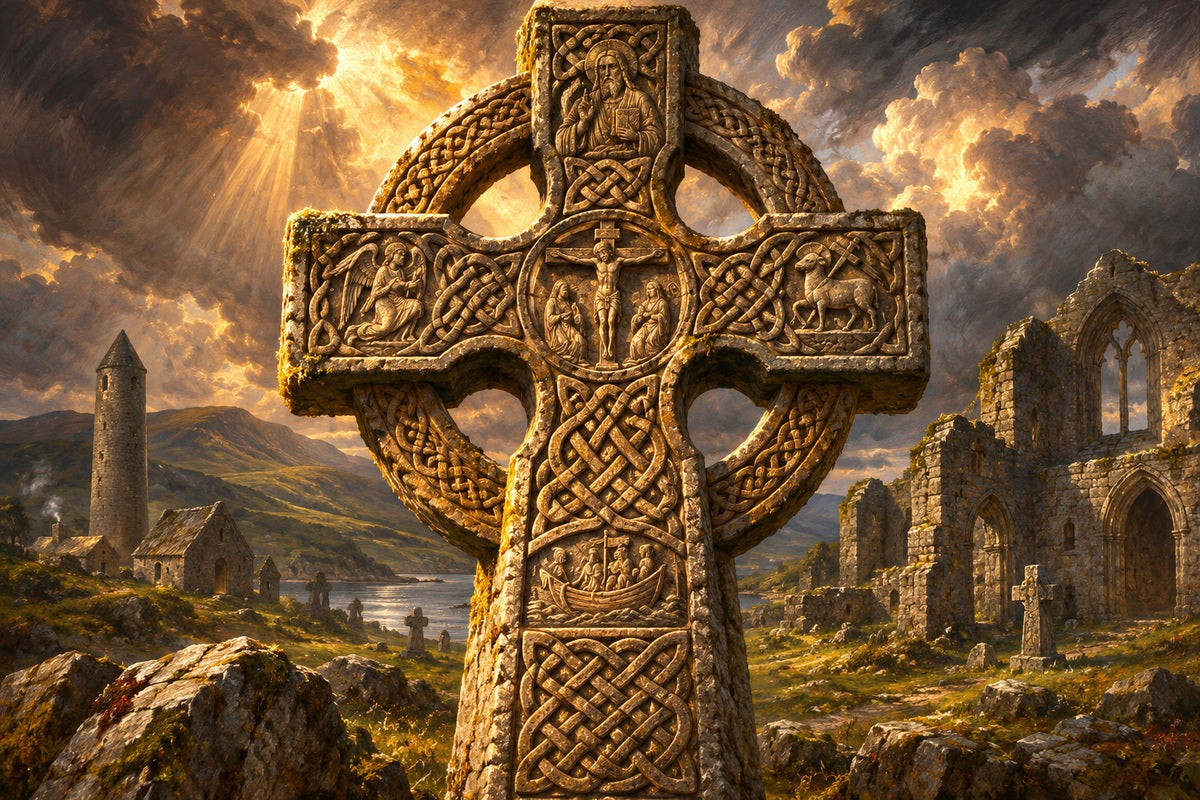
The Celtic Cross is a design that combines a tall cross with a circular ring.
The ring surrounds the intersection of the vertical and horizontal bars of the cross, giving it a different outline from a conventional cross.
In medieval Ireland and Scotland, large stone crosses in this shape were erected at abbeys and other sites.
These stone crosses, some reaching several meters in height, are finely carved with biblical scenes, figures, animals, and geometric patterns.
Main Features of the Celtic Cross
- Cross:The central shape representing the Christian faith.
- Ring:A ring surrounding the intersection of the vertical and horizontal bars. The defining feature of the Celtic Cross.
- Shaft:The column-like section of medieval large crosses, used to raise the cross to a high position.
- Relief Decoration:Carved sections depicting biblical figures and stories, animals, and geometric patterns.
- Base:A stone foundation provided to support the large cross.
Crosses with a ring are also called a "Ringed Cross" in English.
Medieval large stone crosses are also known as "High Crosses" and are renowned as representative works of early Christian art in Ireland.
Meaning of the Celtic Cross | Why It Symbolizes Faith, Eternity, and Protection
At the heart of the Celtic Cross is the Christian faith.
Medieval stone crosses were carved with the crucifixion, resurrection, and Last Judgment of Christ, serving to convey religious teachings.
Based on their shape and history of use, they are now cherished as a motif with the following meanings.
- Faith:The Christian faith represented by the cross itself.
- Eternity:An endless existence or eternal life associated with the ring.
- Protection:The desire for divine protection by wearing a religious symbol.
- Hope and Resurrection:Meaning associated with the resurrection of Christ and eternal life.
- Traditional and Cultural Connection:A symbol representing the history and culture of Ireland and Scotland.
What Does the Ring of the Celtic Cross Mean?
The ring that characterizes the Celtic Cross has inspired various interpretations over time.
Historic Environment Scotland, which manages Scotland's historic environment, explains that the ring on the Cross of Saint Martin on the Isle of Iona symbolizes the eternal existence of Christ.
Heritage Ireland, which introduces Ireland's cultural heritage, also presents the theory that the ring symbolizes the universe, with the crucifixion of Christ at its center representing a pivotal event in the history of the universe.
The unified form of the ring and the cross became a distinctive design that visually expressed religious meaning.
The Ring Also Served a Structural Role in Supporting the Cross
The ring of the Celtic Cross also served a role in stone construction.
Large stone crosses have long horizontal arms that are prone to damage.
By connecting the arms and shaft of the cross with a ring, the entire stone structure can be reinforced.
This structure is important for understanding why medieval large crosses developed their distinctive shape.
Origins and Emergence of the Celtic Cross | History of Ireland and Scotland
Representative artifacts leading to the modern form of the Celtic Cross remain in early medieval Ireland and Scotland.
Large stone crosses began to be made around the 8th and 9th centuries, primarily at abbeys.
High Crosses Developed at Abbeys
By the 7th and 8th centuries, abbeys such as Armagh, Clonmacnoise, Kildare, and Glendalough had become important religious centers in Ireland.
These abbeys were centers of manuscript production, metalwork, and stone carving, fostering the development of distinctive decorative arts.
The large stone crosses produced there are known as High Crosses.
Many High Crosses were carved with biblical stories and erected as monuments to convey religious teachings.
They also served to mark abbey lands or represent the authority of kings and powerful figures.
Iona and the Development of the Celtic Cross
The Isle of Iona in southwestern Scotland is an important site in the history of the Celtic Cross.
In 563, Saint Columba and his companions established an abbey on the Isle of Iona.
This abbey became an important religious center in the British Isles, and by the 8th century, stone carving, metalwork, and manuscript production had flourished there.
Early stone crosses still remain on the Isle of Iona today.
The most notable examples are the Cross of Saint John and the Cross of Saint Martin.
The Cross of Saint Martin and the Meaning of the Ring
The Cross of Saint Martin on the Isle of Iona is a stone cross made around the mid-9th century.
It still stands in its original location and is known as a representative example of a cross with a ring.
According to Historic Environment Scotland, the arms of the Cross of Saint Martin are designed to be shorter than those of the earlier Cross of Saint John.
Although improvements were made to account for the weight of the stone, the distinctive ring was retained.
This indicates that the ring was considered an important element determining the appearance and symbolism of the cross.
Why Were Celtic Crosses Erected?
Medieval large Celtic crosses were religious monuments that served various purposes.
One of their most important roles was to convey biblical stories to the people.
Biblical Stories Carved in Stone
Many High Crosses in Ireland feature relief carvings of scenes from the Old and New Testaments.
Representative subjects include the following:
- Adam and Eve:The Old Testament story of the beginning of humanity and original sin.
- The Crucifixion of Christ:The scene of Jesus Christ being crucified.
- The Resurrection of Christ:The resurrection from death and a central teaching of the Christian faith.
- The Last Judgment:The scene of people being judged in the afterlife.
- Stories of Saints:Scenes related to Christian saints and monastic life.
These images were used to visually express the contents of the Bible and convey the Christian faith.
Crosses erected on abbey grounds served as places where people could encounter prayer and religious teachings.
Monuments Representing the Authority of Abbeys and Kings
Large stone crosses required advanced stone-carving techniques and considerable labor to produce.
Therefore, erecting a cross also served to demonstrate the wealth and technical skill of an abbey or the authority of its patron.
In fact, records remain of kings and abbey leaders who were involved in the production of famous High Crosses in Ireland.

Famous Celtic Crosses Remaining in Ireland
Many large Celtic crosses made in the Middle Ages remain in Ireland.
Among them, the crosses at Monasterboice and Clonmacnoise are renowned for the quality of their carvings and their excellent state of preservation.
Muiredach's Cross at Monasterboice
At Monasterboice in County Louth, Ireland, there is a famous stone cross known as Muiredach's Cross.
It stands approximately 5 meters tall and dates from the early 10th century.
The shaft of the cross is inscribed with a dedication to Abbot Muiredach. Muiredach died in 924.
The surface of the cross is finely carved with numerous biblical scenes, including the crucifixion of Christ and the Last Judgment.
The Last Judgment scene, in particular, depicts Archangel Michael weighing souls and people being saved.
Muiredach's Cross is a representative work that conveys the religious views and advanced stone-carving techniques of medieval Ireland.
The Cross of the Scriptures at Clonmacnoise
At Clonmacnoise in central Ireland, there is a stone cross known as the Cross of the Scriptures.
Made around 914, it is known for being carved with numerous biblical stories.
The relief carvings depict the Last Judgment and the burial of Christ, among other scenes, and serve as an important source for understanding the religious teachings of the time.
Clonmacnoise has a total of three decorated High Crosses, the originals of which are now preserved and displayed in the local museum.
Replicas are placed at their original sites.
Comparison of Representative Celtic Crosses
| Cross Name | Location | Production Period | Features |
|---|---|---|---|
| Cross of Saint John | Iona, Scotland | 8th Century | An early large stone cross with a ring |
| Cross of Saint Martin | Iona, Scotland | Mid-9th Century | Features a ring and still stands in its original location |
| Muiredach's Cross | Monasterboice, Ireland | Early 10th Century | Intricate relief carvings of the crucifixion and the Last Judgment |
| Cross of the Scriptures | Clonmacnoise, Ireland | Around 914 | A representative monument carved with biblical stories |
Differences Between the Celtic Cross and a Conventional Cross
The Celtic Cross and a conventional Christian cross share the basic shape of a cross.
The most obvious difference is whether the intersection is surrounded by a ring.
| Comparison Item | Celtic Cross | Conventional Latin Cross |
|---|---|---|
| Basic Shape | Combines a cross with a ring | Composed of a vertical and horizontal bar |
| Main Meanings | Christian faith, eternity, cultural tradition | Christian faith, crucifixion, salvation |
| Historical Characteristics | Developed as stone crosses in Ireland and Scotland | Used throughout the Christian world |
| Representative Decorations | Ring, biblical relief carvings, knotwork, and geometric patterns | Images of Christ and other religious decorations |
The ring of the Celtic Cross is a distinctive element that greatly changes its appearance.
Even in modern pendants, the combination of a cross and a ring is a key feature used to identify a Celtic Cross.
When Were Celtic Crosses First Used as Accessories?
The Celtic Cross evolved from medieval large stone carvings into wearable decorative items in later periods.
In the 19th century, in particular, a movement to re-evaluate ancient Celtic culture emerged in Ireland and Scotland, and the Celtic Cross once again gained attention as a design for jewelry, monuments, and architectural decoration.
The 19th-Century Celtic Revival Movement
From the 19th to the 20th century, a movement to incorporate Celtic culture into art and literature spread through Ireland and Scotland.
This movement is known as the "Celtic Revival."
Medieval stone crosses and decorative patterns were re-evaluated, and Celtic-style designs were incorporated into jewelry, tombstones, and architecture.
This connection to the decorative culture that flourished during this period can also be seen in modern accessories featuring the Celtic Cross.
A Gold Celtic Cross Pendant Made Around 1869
A concrete example of the Celtic Cross being used as a decorative item is the "Kildonan Gold Cross" from around 1869.
This cross-shaped decorative item was made and sold by Glasgow jeweler D. C. Rait & Sons using Scottish gold.
The intersection of the cross features a ring, and the design is based on the medieval stone crosses that remain on the Isle of Iona.
The front is carved with plant patterns, and a daisy is depicted in the center.
This decorative item could be worn as a brooch or a pendant.
An exhibition at the University of Edinburgh explained that fashion magazines of the time also featured the style of wearing the pendant suspended from a black velvet ribbon.
Thus, in the 19th century, the Celtic Cross was produced as jewelry that inherited the form of historic stone carvings.
The Meaning Imbued in Celtic Cross Accessories
Today, the Celtic Cross is also used in accessories such as pendants and rings.
Its design combines the meaning of the Christian cross with the symbol of eternity associated with the ring.
Main Accessory Designs
- Simple Celtic Cross:A design combining only a cross and a ring. Its distinctive outline stands out.
- Celtic Cross with Knotwork:A design incorporating intricate knotwork decorations on the surface of the cross.
- Type Replicating a Stone Cross:A design based on medieval High Crosses, featuring relief carvings and geometric patterns.
- Celtic Cross with Gemstones:A decorative design with stones set in the center or arms of the cross.
- Type with Metal Carving:A design with plant patterns or other designs engraved on the surface of the ring or cross.
In silver accessories, in particular, the distinctive shape created by the ring and cross is often enhanced with fine carvings and three-dimensional forms.
The wide range of decorations, from designs that give the cross a simple outline to substantial designs reminiscent of medieval stone crosses, is another characteristic of the Celtic Cross.

Summary | The Meaning and Decorative Appeal of the Celtic Cross
The Celtic Cross is a historic Christian symbol with a distinctive shape in which the intersection of the cross is surrounded by a ring.
From around the 8th and 9th centuries, large stone crosses flourished at abbeys in Ireland and Scotland and were used as monuments to convey biblical stories and religious teachings.
The distinctive ring served to reinforce the stone carvings and was also given meaning as a connection between eternal existence, the universe, and the Christian faith.
Works that still convey the advanced stone-carving techniques of the time remain today, including Muiredach's Cross at Monasterboice and the Cross of Saint Martin on the Isle of Iona.
Furthermore, pendants and brooches based on these crosses were also made during the Celtic Revival of the 19th century.
The Celtic Crosses used in modern silver accessories also carry a history inherited from medieval faith and the decorative cultures of Ireland and Scotland.